Skip to main content
Microeconomics
My Course
Learn
Exam Prep
AI Tutor
Study Guides
Flashcards
Explore
Try the app
My Course
Learn
Exam Prep
AI Tutor
Study Guides
Flashcards
Explore
Try the app
Back
Criticisms of Fiscal Policy quiz
You can tap to flip the card.
What is the recognition lag in fiscal policy?
You can tap to flip the card.
👆
What is the recognition lag in fiscal policy?
The recognition lag is the delay in identifying that the economy is in a recession, which can take several months before action is taken.
Track progress
Control buttons has been changed to "navigation" mode.
1/15
Related flashcards
Recommended videos
Criticisms of Fiscal Policy definitions
Criticisms of Fiscal Policy
15 Terms
Guided course
04:16
Crowding Out Effect
Guided course
02:19
Political Environment
Guided course
01:39
Pro-Cyclical Fiscal Policy
Terms in this set (15)
Hide definitions
What is the recognition lag in fiscal policy?
The recognition lag is the delay in identifying that the economy is in a recession, which can take several months before action is taken.
What is the operational lag in fiscal policy?
Operational lag is the time between the approval of fiscal policy and when its effects are actually felt in the economy, which can take months.
Why can fiscal policy be less effective than monetary policy?
Fiscal policy is less effective due to longer recognition and operational lags compared to monetary policy.
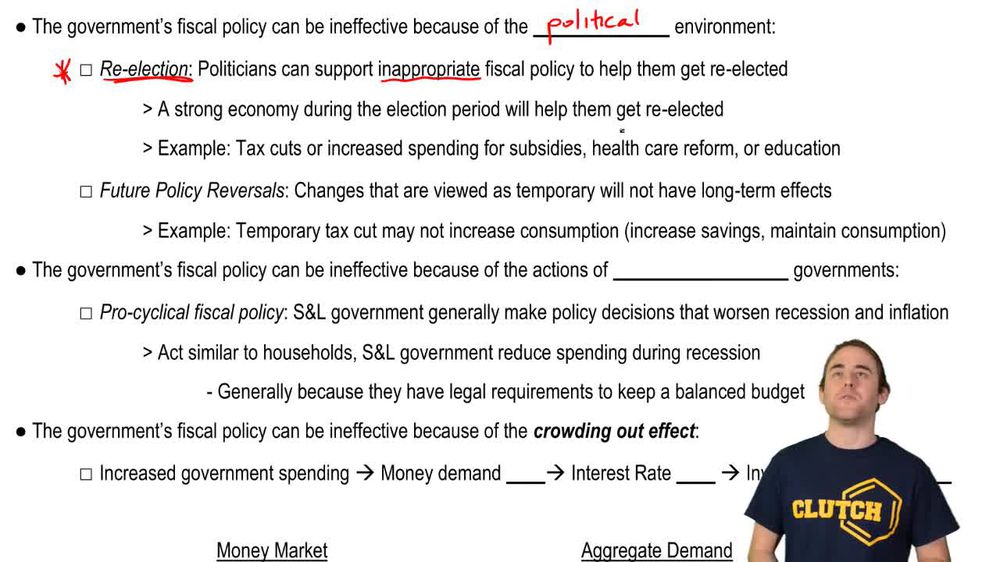
How can political motivations affect fiscal policy decisions?
Politicians may support fiscal policies that help them get reelected, even if those policies are not appropriate for long-term economic growth.
What is a policy reversal in the context of fiscal policy?
A policy reversal is when a new government undoes previous fiscal measures, making temporary changes less effective for long-term planning.
Why might tax cuts not always increase consumption?
If people believe tax cuts are temporary and will be reversed, they may save the extra money instead of spending it.
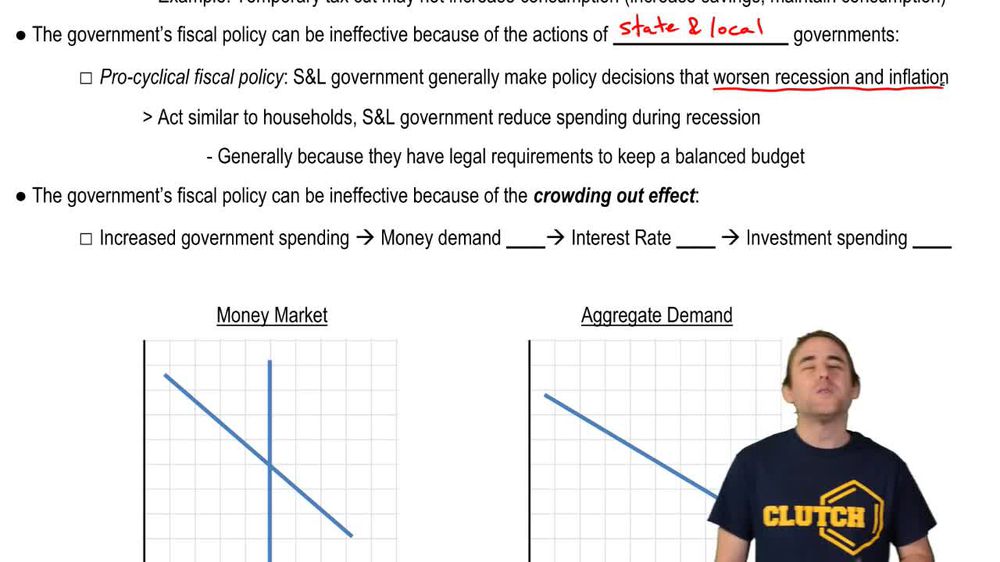
What is procyclical fiscal policy at the state and local government level?
Procyclical fiscal policy is when state and local governments reduce spending during recessions, worsening economic downturns.
Why do state and local governments often reduce spending during recessions?
They are legally required to keep balanced budgets, so lower tax revenues force them to cut spending.
What is the crowding out effect in fiscal policy?
The crowding out effect occurs when increased government borrowing raises interest rates, reducing private investment spending.
How does increased government spending affect the demand for money?
Increased government spending raises the demand for money, which can lead to higher interest rates.
What happens to investment spending when interest rates rise due to government borrowing?
Higher interest rates make borrowing more expensive for firms, leading to a decrease in investment spending.
How does the crowding out effect impact long-run economic growth?
It reduces investment spending, which is crucial for future productivity and long-run economic growth.
What is the relationship between government spending and aggregate demand?
Government spending increases aggregate demand, but if it crowds out investment, the net effect may be smaller.
Why is investment spending important for the economy's future?
Investment spending funds factories and equipment, which boost future productivity and economic growth.
How does the fixed money supply by the Fed relate to the crowding out effect?
With a fixed money supply, increased government demand for money raises interest rates, leading to crowding out of private investment.
 BackBack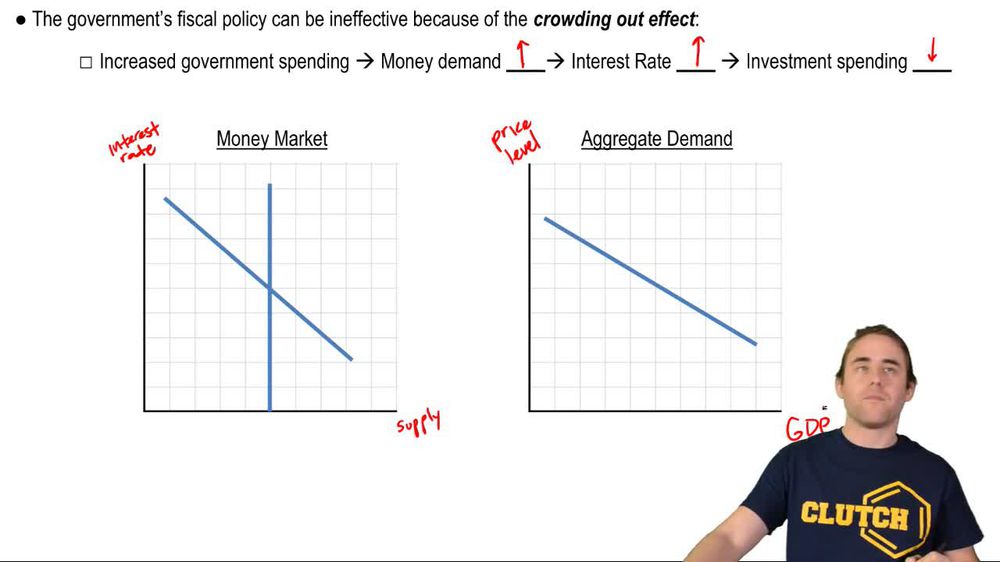
 04:16
04:16