Skip to main content
Microeconomics
My Course
Learn
Exam Prep
AI Tutor
Study Guides
Flashcards
Explore
Try the app
My Course
Learn
Exam Prep
AI Tutor
Study Guides
Flashcards
Explore
Try the app
Back
Perfect Competition Profit on the Graph quiz
You can tap to flip the card.
Where does a perfectly competitive firm find its profit maximizing quantity on a graph?
You can tap to flip the card.
👆
Where does a perfectly competitive firm find its profit maximizing quantity on a graph?
A perfectly competitive firm finds its profit maximizing quantity where marginal revenue (MR) equals marginal cost (MC).
Track progress
Control buttons has been changed to "navigation" mode.
1/15
Related flashcards
Related practice
Recommended videos
Perfect Competition Profit on the Graph definitions
Perfect Competition Profit on the Graph
15 Terms
Perfect Competition Profit on the Graph
11. Perfect Competition
10 problems
Topic
Short Run Shutdown Decision
11. Perfect Competition
10 problems
Topic
11. Perfect Competition
11 topics
15 problems
Chapter
Guided course
13:25
Profit on the Graph in Perfect Competition
3
views
Terms in this set (15)
Hide definitions
Where does a perfectly competitive firm find its profit maximizing quantity on a graph?
A perfectly competitive firm finds its profit maximizing quantity where marginal revenue (MR) equals marginal cost (MC).
In perfect competition, what is the relationship between price, average revenue, and marginal revenue?
In perfect competition, price equals both average revenue (AR) and marginal revenue (MR).
How do you calculate profit per unit for a firm?
Profit per unit is calculated as price minus average total cost (ATC).
What is the formula for total profit on the graph?
Total profit is (Price - ATC) multiplied by the quantity produced.
What does it mean if the price is greater than the average total cost at the profit maximizing quantity?
If price is greater than ATC, the firm makes a profit.
What does it mean if the price is less than the average total cost at the profit maximizing quantity?
If price is less than ATC, the firm incurs a loss.
What happens if price equals average total cost at the profit maximizing quantity?
If price equals ATC, the firm breaks even with no profit or loss.
Why might the profit maximizing quantity also be called the loss minimizing quantity?
Because even if the firm is making a loss, producing where MR = MC ensures the loss is as small as possible.
On a graph, how do you identify the profit maximizing quantity?
You find the intersection point of the marginal revenue and marginal cost curves and drop down to the quantity axis.
What area on the graph represents total profit?
The area between the price line and the ATC curve at the profit maximizing quantity, multiplied by quantity, represents total profit.
If a firm cannot produce a fractional unit at the MR=MC point, what should it do?
The firm should choose the lower whole number quantity to avoid marginal cost exceeding marginal revenue.
What is the first step in calculating profit or loss on a graph?
The first step is to find where marginal revenue equals marginal cost to determine the quantity to produce.
How do you find the price to use in profit calculations on the graph?
The price is found on the demand curve at the profit maximizing quantity.
What does the vertical distance between the price and ATC curves at the profit maximizing quantity represent?
It represents the profit (if price > ATC) or loss (if price < ATC) per unit.
Why is the demand curve flat for a perfectly competitive firm?
The demand curve is flat because the firm is a price taker and can sell any quantity at the market price.
 BackBack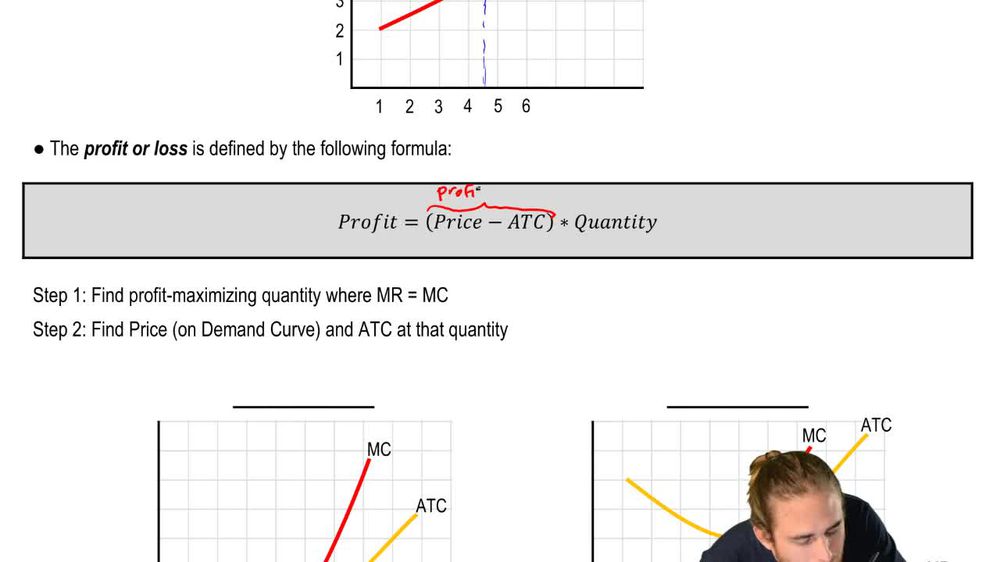
 13:25
13:25