Skip to main content
Microeconomics
My Course
Learn
Exam Prep
AI Tutor
Study Guides
Flashcards
Explore
Try the app
My Course
Learn
Exam Prep
AI Tutor
Study Guides
Flashcards
Explore
Try the app
Back
Characteristics of Oligopoly definitions
You can tap to flip the card.
Oligopoly
You can tap to flip the card.
👆
Oligopoly
A market structure with few producers, allowing some control over price and strategic interaction among firms.
Track progress
Control buttons has been changed to "navigation" mode.
1/13
Related flashcards
Related practice
Recommended videos
Characteristics of Oligopoly quiz #1
Characteristics of Oligopoly
39 Terms
Characteristics of Oligopoly quiz #2
Characteristics of Oligopoly
10 Terms
Characteristics of Oligopoly
14. Oligopoly
10 problems
Topic
One-Time Games and the Prisoner's Dilemma
14. Oligopoly
7 problems
Topic
14. Oligopoly
6 topics
14 problems
Chapter
Guided course
04:45
Characteristics of Oligopoly
5
views
Guided course
05:16
Oligopoly Barriers to Entry
3
views
Terms in this set (13)
Hide definitions
Oligopoly
A market structure with few producers, allowing some control over price and strategic interaction among firms.
Duopoly
A special case with only two producers, often resulting from economies of scale and strategic rivalry.
Market Power
The ability to influence price due to limited competition, stronger than in perfect competition but weaker than monopoly.
Barriers to Entry
Obstacles preventing new firms from entering, such as resource ownership, regulation, or cost advantages.
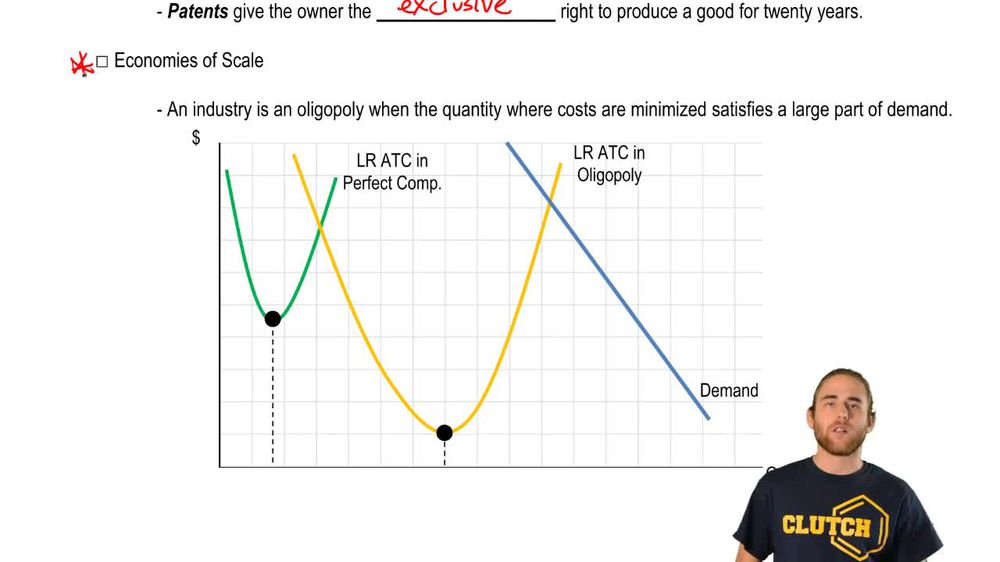
Economies of Scale
Cost advantages from increased production, leading to lower average costs and favoring fewer, larger firms.
Ownership of Key Resources
Exclusive control over essential inputs, restricting access for potential competitors and maintaining market dominance.
Government Regulation
Legal restrictions, including patents, that protect incumbents and limit new entrants in the market.
Interdependence
Mutual reliance among firms, where each considers rivals' actions when making pricing or output decisions.
Price Maker
A seller with some discretion to set prices, unlike in perfect competition, but still constrained by rivals.
Identical Goods
Products with no distinguishable differences, such as aluminum, supplied by a few firms in the market.
Differentiated Goods
Products with unique features or branding, like Coke and Pepsi, offered by limited suppliers.
Minimum Efficient Scale
The lowest production level where average costs are minimized, often achieved by large firms in oligopoly.
Natural Duopoly
A situation where only two firms efficiently meet market demand due to substantial economies of scale.
 BackBack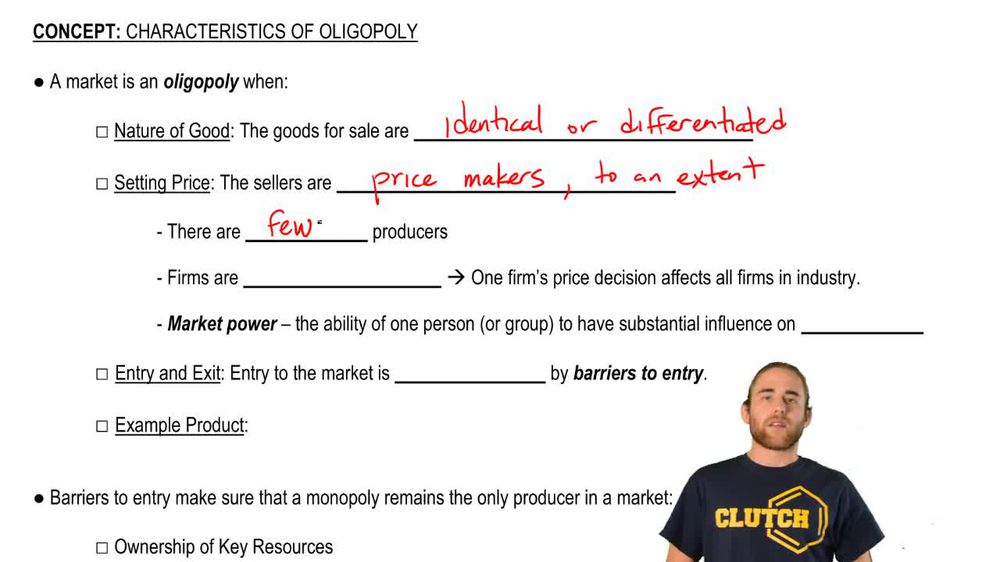
 04:45
04:45