Skip to main content
Microeconomics
My Course
Learn
Exam Prep
AI Tutor
Study Guides
Flashcards
Explore
Try the app
My Course
Learn
Exam Prep
AI Tutor
Study Guides
Flashcards
Explore
Try the app
Back
Calculating Bond and Stock Prices definitions
You can tap to flip the card.
Present Value
You can tap to flip the card.
👆
Present Value
Represents today's worth of future cash flows, calculated by discounting each payment to reflect time value of money.
Track progress
Control buttons has been changed to "navigation" mode.
1/15
Related flashcards
Recommended videos
Calculating Bond and Stock Prices quiz
Calculating Bond and Stock Prices
15 Terms
Guided course
05:16
Calculating Stock and Bond Price
Terms in this set (15)
Hide definitions
Present Value
Represents today's worth of future cash flows, calculated by discounting each payment to reflect time value of money.
Future Value
Refers to the amount a cash flow will grow to after a specified period, considering interest or growth rates.
Bond Price
Equals the sum of discounted coupon payments and principal, reflecting the total present value of future payouts.
Coupon
Periodic interest payment made by a bond issuer to the bondholder, typically received annually or semi-annually.
Principal
Original amount lent to a bond issuer, returned to the bondholder at maturity in addition to coupon payments.
Discount Rate
Percentage used to reduce future cash flows to their present value, reflecting opportunity cost and risk.
Dividend
Regular payment to shareholders from company profits, forming the primary cash flow for stock valuation.
Growth Rate
Expected annual increase in dividends or cash flows, crucial for estimating stock prices using valuation formulas.
Time Value of Money
Concept that a dollar today is worth more than a dollar in the future due to earning potential and inflation.
Stock Price
Calculated as the present value of expected future dividends, often adjusted for anticipated growth.
Cash Flow
Monetary payments received from investments, including coupons, principal, or dividends, used in valuation.
Market Equilibrium
State where asset prices reflect all available information, ensuring no unexploited profit opportunities.
Economic Profit
Surplus earned above opportunity costs, often zero in competitive markets due to efficient pricing.
Maturity
Date when a bond's principal is repaid to the investor, marking the end of the bond's life.
Investment Decision
Choice based on comparing present values of future cash flows to current prices, guiding asset purchases.
 BackBack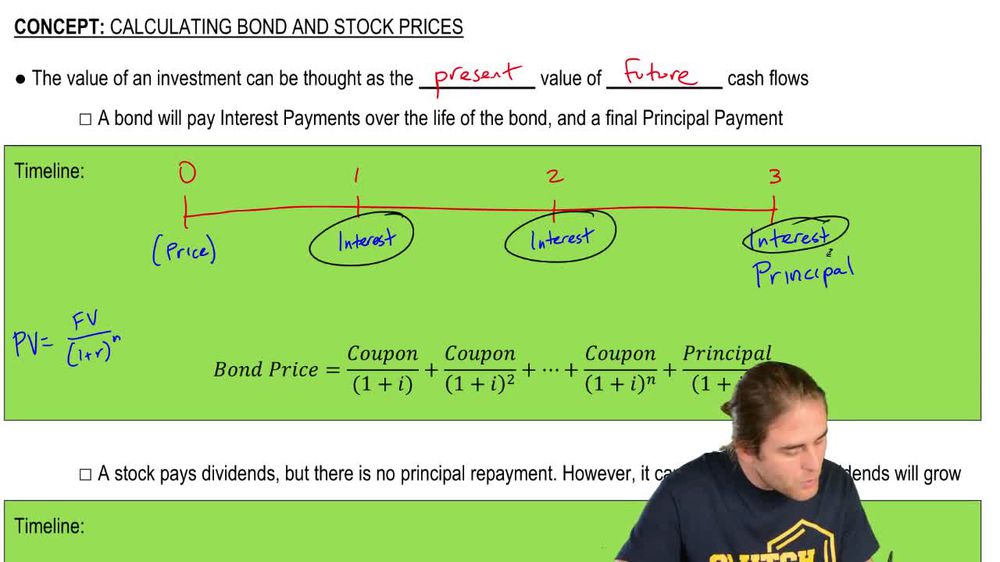
 05:16
05:16