Skip to main content
Microeconomics
My Course
Learn
Exam Prep
AI Tutor
Study Guides
Flashcards
Explore
Try the app
My Course
Learn
Exam Prep
AI Tutor
Study Guides
Flashcards
Explore
Try the app
Back
Business Cycles and Their Characteristics definitions
You can tap to flip the card.
Business Cycle
You can tap to flip the card.
👆
Business Cycle
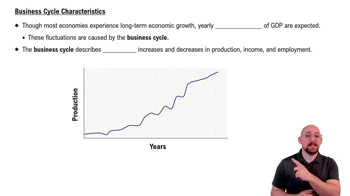
Pattern of alternating periods of economic growth and decline, reflected in changes to production, income, and employment.
Track progress
Control buttons has been changed to "navigation" mode.
1/15
Related flashcards
Recommended videos
Business Cycles and Their Characteristics quiz
Business Cycles and Their Characteristics
15 Terms
Guided course
02:33
Key Ideas of the Business Cycle
1
views
Guided course
04:18
Causes of Business Cycles
1
views
01:46
Business Cycle Characteristics
1
views
Terms in this set (15)
Hide definitions
Business Cycle
Pattern of alternating periods of economic growth and decline, reflected in changes to production, income, and employment.
GDP
Total value of goods and services produced within a country, used to track economic performance and business cycle phases.
Expansion
Phase marked by rising production, income, and employment, often accompanied by increasing inflation.
Contraction
Phase characterized by falling production, income, and employment, typically leading to higher unemployment.
Peak
Highest point in the business cycle, signaling the end of expansion and the start of contraction.
Trough
Lowest point in the business cycle, indicating the end of contraction and the beginning of expansion.
Unemployment
Condition where individuals seeking work are unable to find jobs, rising during contractions and falling during expansions.
Inflation
General increase in price levels, typically moving opposite to unemployment during business cycle phases.
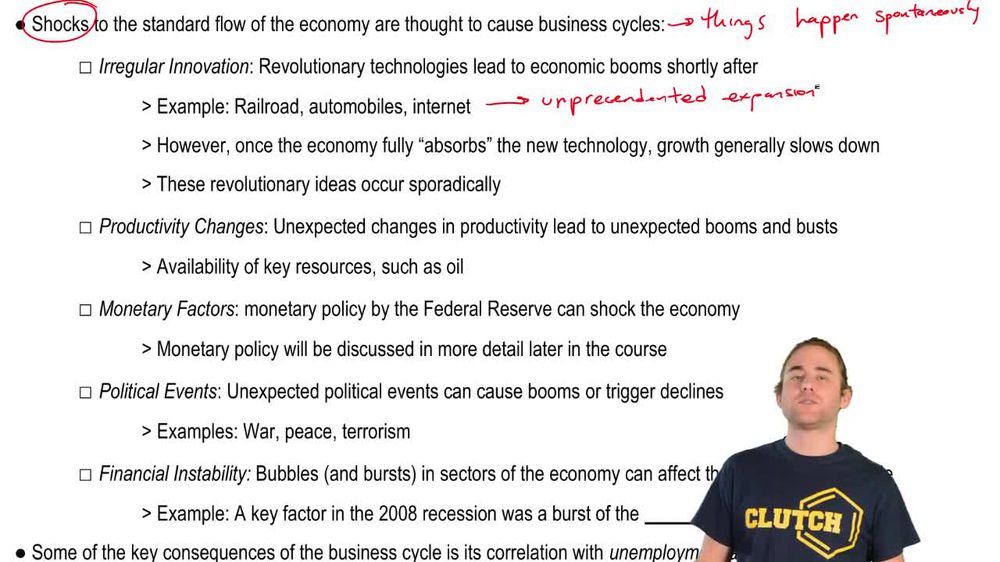
Shock
Unexpected event disrupting economic activity, causing sudden expansions or recessions.
Irregular Innovation
Unpredictable technological advances or inventions that trigger rapid economic growth.
Productivity Change
Alteration in output efficiency, often due to technology or resource availability, impacting economic growth.
Monetary Policy
Actions by central banks, such as adjusting money supply, that influence economic activity and business cycle.
Political Event
Occurrences like wars or peace agreements that unexpectedly affect economic stability and business cycle.
Financial Instability
Disruptions in financial markets, such as asset bubbles, leading to economic downturns.
Jobless Recovery
Period when economic growth resumes but unemployment remains elevated, often following a recession.
 BackBack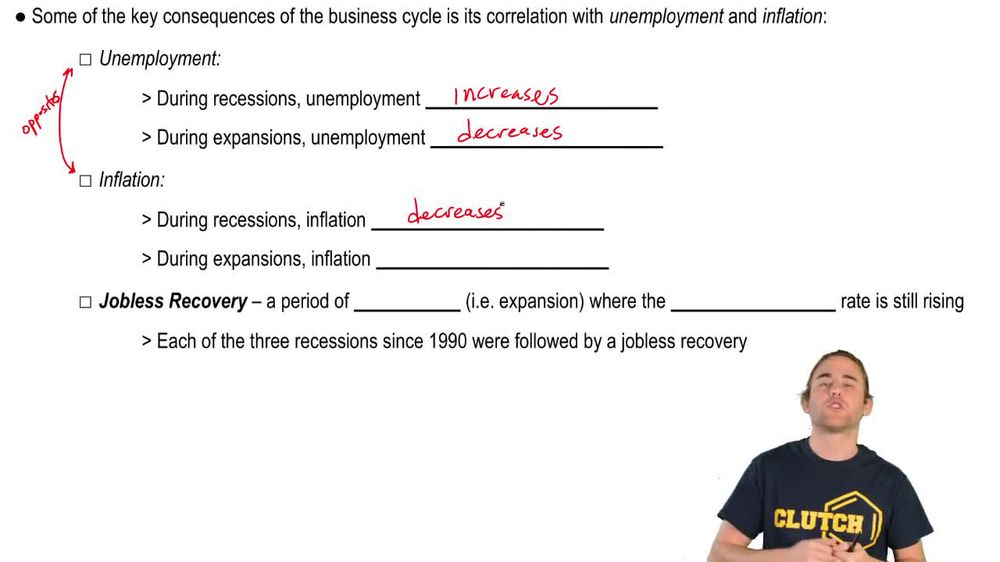
 02:33
02:33