Skip to main content
Microeconomics
My Course
Learn
Exam Prep
AI Tutor
Study Guides
Flashcards
Explore
Try the app
My Course
Learn
Exam Prep
AI Tutor
Study Guides
Flashcards
Explore
Try the app
Back
Balance of Payments: Introduction definitions
You can tap to flip the card.
Balance of Payments
You can tap to flip the card.
👆
Balance of Payments
A comprehensive record tracking all monetary transactions between a country and the rest of the world, ensuring inflows and outflows sum to zero.
Track progress
Control buttons has been changed to "navigation" mode.
1/13
Related flashcards
Recommended videos
Balance of Payments: Introduction quiz
Balance of Payments: Introduction
15 Terms
Guided course
05:29
Balance of Payments: Introduction
Terms in this set (13)
Hide definitions
Balance of Payments
A comprehensive record tracking all monetary transactions between a country and the rest of the world, ensuring inflows and outflows sum to zero.
Current Account
A section summarizing short-term flows such as net exports, investment income, and transfers between a country and others.
Financial Account
A section detailing long-term asset transactions, including foreign investments and ownership of stocks, bonds, and property.
Net Exports
A measure calculated as the difference between the value of goods and services exported and those imported.
Trade Deficit
A situation where the value of imports exceeds the value of exports, resulting in a negative net export balance.
Investment Income
Earnings from foreign assets, such as interest, dividends, and profits, included in the current account.
Transfers
Monetary flows not linked to goods or services, such as remittances or aid, recorded in the current account.
Foreign Assets
Holdings like stocks, bonds, property, or factories located abroad, owned by domestic residents or entities.
US Assets
Financial or physical holdings within the United States, owned by foreign individuals or organizations.
Open Economy
A system where a country engages in trade and financial transactions with other nations, rather than remaining isolated.
Capital Account
A minor section recording trivial items such as debt forgiveness and movement of intangible assets, often negligible.
Statistical Discrepancy
An adjustment made to ensure the balance of payments totals zero, accounting for measurement errors or omissions.
Economic Equilibrium
A state where inflows and outflows in the balance of payments are matched, maintaining overall stability.
 BackBack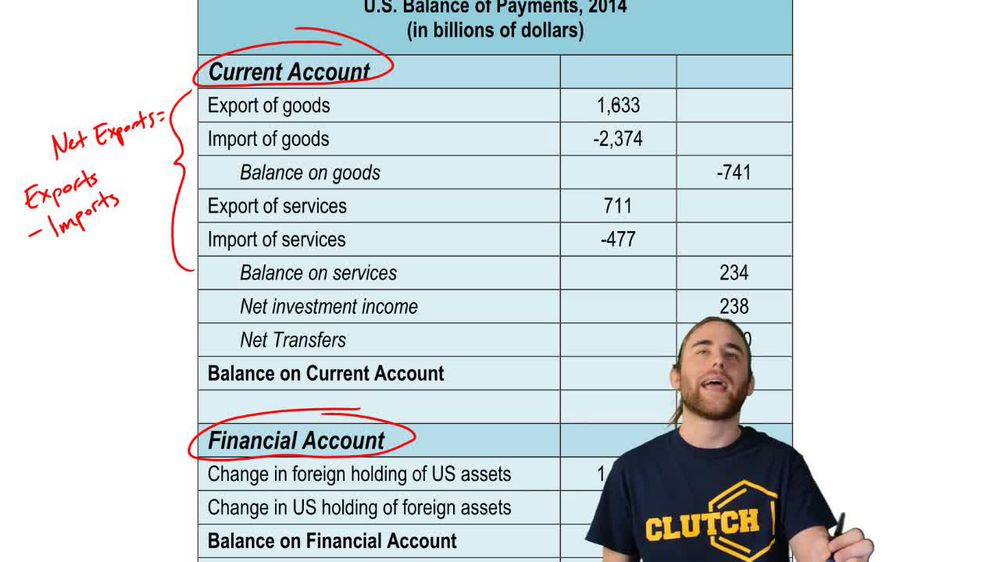
 05:29
05:29