What is the formula for average propensity to consume (APC)?
APC is calculated as total consumption divided by total disposable income.
How do you calculate average propensity to save (APS)?
APS is calculated as total savings divided by total disposable income.
What does disposable income refer to in the context of APC and APS?
Disposable income is the income left after paying taxes, available for consumption or saving.
What is the main difference between average and marginal propensity to consume?
Average propensity measures total consumption relative to income, while marginal propensity measures the change in consumption from an additional dollar of income.
How is marginal propensity to consume (MPC) defined?
MPC is the change in consumption resulting from an additional dollar of income.
What does marginal propensity to save (MPS) measure?
MPS measures the change in savings resulting from an additional dollar of income.
Why are APC and APS important for understanding consumer behavior?
They show how much of income is spent or saved, helping analyze spending and saving patterns.
What is the relationship between consumption and disposable income in APC?
APC shows the proportion of disposable income that is used for consumption.
How does APS relate to disposable income?
APS shows the proportion of disposable income that is saved.
What does the term 'marginal' mean in economics?
Marginal refers to the effect of one more unit, such as an additional dollar of income.
How do APC and APS help analyze income elasticity of demand?
They indicate how changes in income affect consumption and saving, which is key to understanding income elasticity.
What is the opportunity cost in the context of marginal propensity to consume and save?
The opportunity cost is the benefit foregone from not consuming or saving the additional dollar of income.
How do APC and APS contribute to understanding market equilibrium?
They help determine how much income is spent or saved, influencing supply and demand in markets.
What are the two main uses of disposable income according to the lesson?
Disposable income is used for either consumption or savings.
Why is it important to distinguish between total and marginal propensities?
Distinguishing helps understand overall behavior versus responses to changes in income.
 Back
Back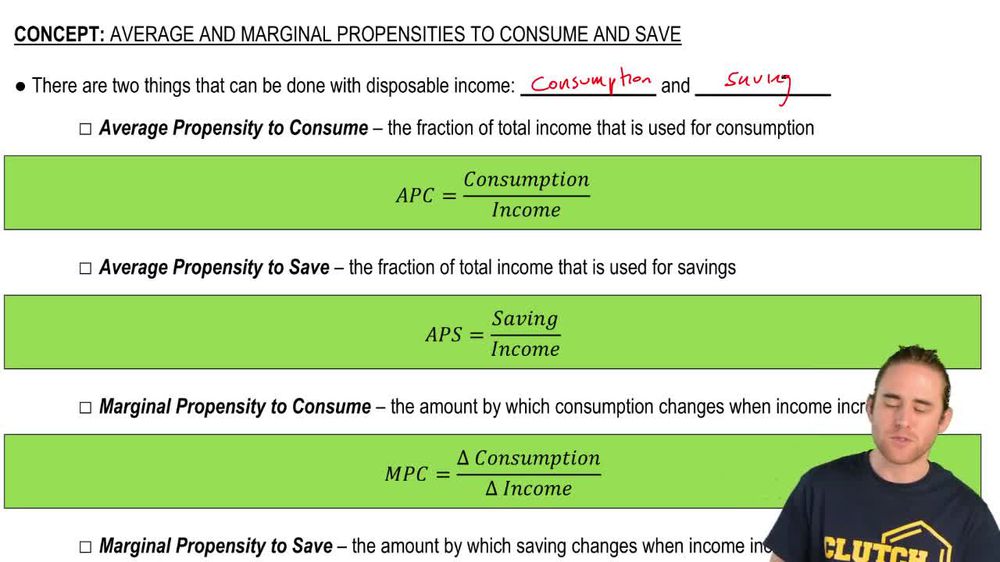
 01:50
01:50