Skip to main content
Microeconomics
My Course
Learn
Exam Prep
AI Tutor
Study Guides
Flashcards
Explore
Try the app
My Course
Learn
Exam Prep
AI Tutor
Study Guides
Flashcards
Explore
Try the app
Back
Austrian Model definitions
You can tap to flip the card.
Austrian Model
You can tap to flip the card.
👆
Austrian Model
Economic framework favoring free markets, explaining cycles of expansion and recession driven by monetary policy and interest rates.
Track progress
Control buttons has been changed to "navigation" mode.
1/15
Related flashcards
Recommended videos
Austrian Model quiz
Austrian Model
15 Terms
Guided course
03:31
Austrian Model
Terms in this set (15)
Hide definitions
Austrian Model
Economic framework favoring free markets, explaining cycles of expansion and recession driven by monetary policy and interest rates.
Business Cycle
Pattern of economic expansions and recessions, influenced by investment and monetary conditions, central to Austrian economic theory.
Expansion
Phase of increased economic activity, often triggered by low borrowing costs and rising investment, preceding a peak.
Recession
Period of declining economic output, typically following excessive investment and a market peak, deepened by low interest rates.
Interest Rate
Cost of borrowing money, set by central banks, which influences investment levels and the severity of economic cycles.
Investment
Allocation of resources to productive assets, stimulated by low borrowing costs, sometimes leading to unsustainable growth.
Free Market
Economic system with minimal government intervention, where prices and production are determined by supply and demand.
Central Bank
Institution managing monetary policy, including setting borrowing costs, which impacts economic cycles and market stability.
Monetary Policy
Actions by financial authorities to control money supply and borrowing costs, affecting investment and economic fluctuations.
Market Equilibrium
State where supply and demand balance, influenced by monetary conditions and investment decisions in Austrian theory.
Housing Bubble
Rapid increase in real estate prices fueled by excessive investment, often ending in a sharp market decline.
Great Recession
Major economic downturn from 2007-2009, exemplifying Austrian theory with its roots in low borrowing costs and housing investment.
Classical Model
Economic approach advocating minimal government intervention, similar to Austrian principles but predating its business cycle focus.
Government Intervention
Actions by authorities to influence economic outcomes, contrasted with Austrian preference for market-driven solutions.
Peak
Highest point in economic activity during a cycle, after which a downturn or recession typically follows.
 BackBack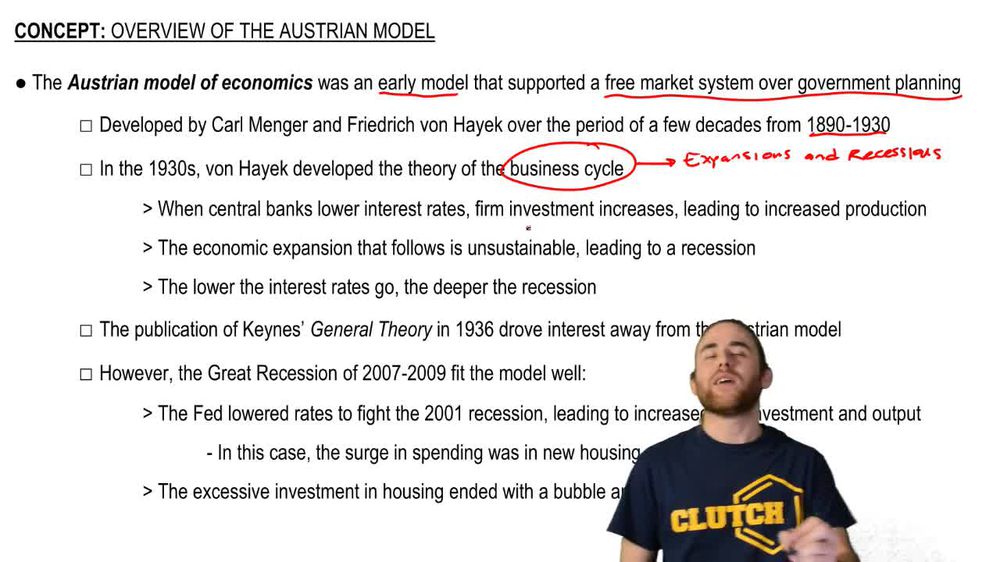
 03:31
03:31