Skip to main content
Microeconomics
My Course
Learn
Exam Prep
AI Tutor
Study Guides
Flashcards
Explore
Try the app
My Course
Learn
Exam Prep
AI Tutor
Study Guides
Flashcards
Explore
Try the app
Back
Areas of Shapes definitions
You can tap to flip the card.
Triangle
You can tap to flip the card.
👆
Triangle
A three-sided polygon whose area can be calculated using a specific formula involving base and height.
Track progress
Control buttons has been changed to "navigation" mode.
1/15
Related flashcards
Related practice
Recommended videos
Areas of Shapes quiz
Areas of Shapes
15 Terms
Areas of Shapes
1. Reading and Understanding Graphs
10 problems
Topic
Fractions Review
1. Reading and Understanding Graphs
10 problems
Topic
1. Reading and Understanding Graphs
9 topics
15 problems
Chapter
Guided course
08:52
Calculating Area of a Triangle on Graph
10
views
Terms in this set (15)
Hide definitions
Triangle
A three-sided polygon whose area can be calculated using a specific formula involving base and height.
Graph
A visual representation with axes used to plot points and shapes for area calculations.
Base
A horizontal or slanted segment of a triangle, measured as the difference between two coordinates.
Height
A perpendicular or vertical segment from the base to the opposite vertex, found by subtracting coordinate values.
Area
A measure of the space inside a shape, calculated for triangles using a formula involving base and height.
Formula
A mathematical expression used to compute the area of a triangle, typically written as 0.5 times base times height.
Unit
A standard measurement used to express the length of base and height on a graph.
Coordinate
A numerical value representing a point's position on the graph, essential for determining base and height.
Segment
A straight line connecting two points, often used to define the base or height of a triangle.
Decimal
A numerical format used in area calculations, especially when dividing numbers like 9 by 2.
Fraction
A numerical expression representing part of a whole, used in area calculations such as 9 over 2.
Visual Aid
A highlighted or labeled element on the graph that helps clarify the calculation process.
Axis
A reference line on the graph, either horizontal or vertical, used to measure coordinates.
Polygon
A closed shape with straight sides, of which the triangle is a specific example.
Region
A specific area on the graph, often highlighted, representing the part of the triangle being calculated.
 BackBack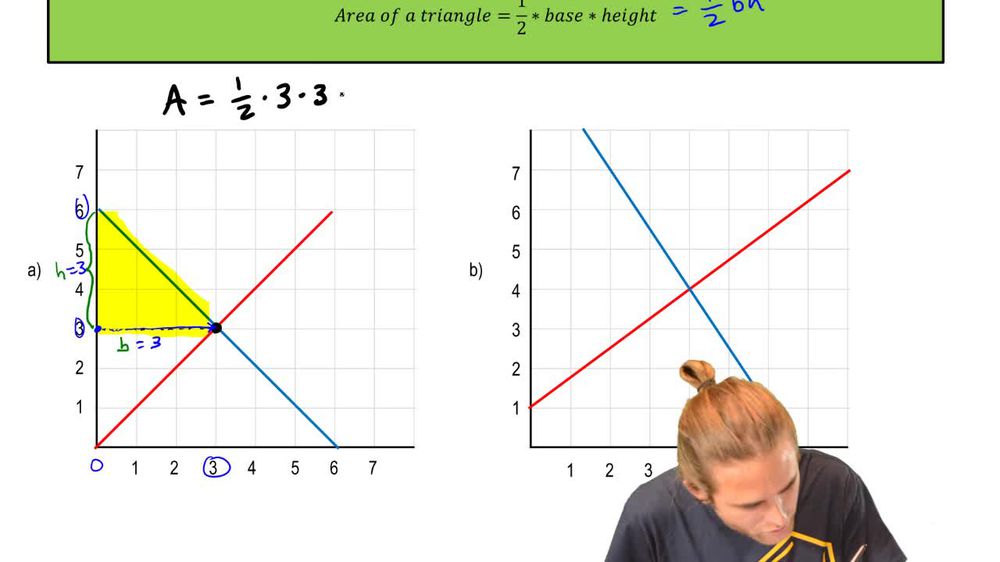
 08:52
08:52