Skip to main content
Microeconomics
My Course
Learn
Exam Prep
AI Tutor
Study Guides
Flashcards
Explore
Try the app
My Course
Learn
Exam Prep
AI Tutor
Study Guides
Flashcards
Explore
Try the app
Back
AE Model: Private Open Economy quiz
You can tap to flip the card.
What components make up aggregate expenditures (AE) in a private open economy?
You can tap to flip the card.
👆
What components make up aggregate expenditures (AE) in a private open economy?
Aggregate expenditures in a private open economy are made up of consumption (C), investment (I), and net exports (NX).
Track progress
Control buttons has been changed to "navigation" mode.
1/15
Related flashcards
Recommended videos
AE Model: Private Open Economy definitions
AE Model: Private Open Economy
14 Terms
Guided course
05:37
Private Open Economy
1
views
Terms in this set (15)
Hide definitions
What components make up aggregate expenditures (AE) in a private open economy?
Aggregate expenditures in a private open economy are made up of consumption (C), investment (I), and net exports (NX).
How is consumption (C) modeled in the private open economy AE model?
Consumption is modeled as C = 2 + 0.5y, where y represents GDP.
What is the equation for aggregate expenditures (AE) in a private open economy?
AE = 3.5 + 0.5y, combining consumption, investment, and net exports.
What does the 45-degree line represent in the AE model?
The 45-degree line represents points where aggregate expenditures equal GDP, indicating equilibrium.
How is macroeconomic equilibrium determined in the AE model for a private open economy?
Equilibrium occurs where the AE line intersects the 45-degree line, meaning spending equals production.
What distinguishes a private open economy from a private closed economy?
A private open economy includes trade (net exports), while a private closed economy does not.
Why are government purchases excluded from the AE model in a private open economy?
Government purchases are excluded because the model assumes there is no government in the economy.
What is the marginal propensity to consume (MPC) in the consumption function provided?
The MPC is 0.5, meaning for every additional unit of GDP, consumption increases by 0.5 units.
How does investment (I) affect the AE line in the private open economy model?
Investment increases the intercept of the AE line, shifting it upward without changing its slope.
What role do net exports (NX) play in the AE model for a private open economy?
Net exports are included in AE, reflecting the impact of trade on total spending and GDP.
What is the intercept of the AE line in the private open economy model?
The intercept is 3.5, representing the sum of autonomous consumption, investment, and net exports when GDP is zero.
How does the slope of the AE line relate to the MPC in this model?
The slope of the AE line is equal to the MPC, which is 0.5 in this case.
At what value of GDP does equilibrium occur in the example provided?
Equilibrium occurs at GDP = 7, where aggregate expenditures also equal 7.
What happens to GDP if investment or net exports change in the private open economy?
Changes in investment or net exports cause a multiplier effect, impacting GDP proportionally.
Why is it important to understand the AE model in a private open economy?
It helps explain how trade and investment determine GDP without government influence, highlighting equilibrium and market supply.
 BackBack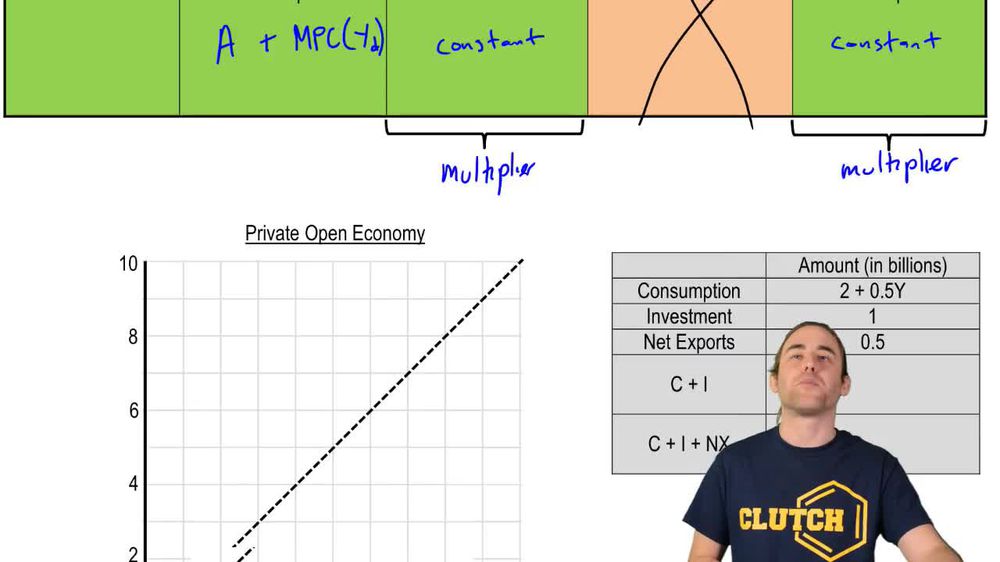
 05:37
05:37