Skip to main content
Microeconomics
My Course
Learn
Exam Prep
AI Tutor
Study Guides
Flashcards
Explore
Try the app
My Course
Learn
Exam Prep
AI Tutor
Study Guides
Flashcards
Explore
Try the app
Back
AE Model and the Multiplier quiz
You can tap to flip the card.
What does the multiplier effect describe in the aggregate expenditure model?
You can tap to flip the card.
👆
What does the multiplier effect describe in the aggregate expenditure model?
It describes how an initial increase in spending leads to a greater overall rise in GDP than the initial amount spent.
Track progress
Control buttons has been changed to "navigation" mode.
1/15
Related flashcards
Recommended videos
AE Model and the Multiplier definitions
AE Model and the Multiplier
15 Terms
Guided course
11:37
AE Model and the Multiplier
1
views
Terms in this set (15)
Hide definitions
What does the multiplier effect describe in the aggregate expenditure model?
It describes how an initial increase in spending leads to a greater overall rise in GDP than the initial amount spent.
Which components make up aggregate expenditures in the AE model?
Aggregate expenditures are made up of consumption, investment, government purchases, and net exports.
How does the marginal propensity to consume (MPC) affect the multiplier?
The MPC determines the size of the multiplier; a higher MPC results in a larger multiplier.
What is the formula for the multiplier in the AE model?
The multiplier is calculated as 1 divided by (1 minus MPC), or 1/(1-MPC).
If the MPC is 0.5, what is the value of the multiplier?
The multiplier is 2, because 1/(1-0.5) = 2.
How do you calculate the total change in GDP from an initial spending boost?
Multiply the initial spending boost by the multiplier to get the total change in GDP.
In the example, if investment spending increases by \$1 billion and the multiplier is 2, what is the total increase in GDP?
The total increase in GDP is \$2 billion.
What role does the slope of the aggregate expenditures line play in the multiplier effect?
The slope, determined by the MPC, affects how much the initial spending boost is multiplied in the economy.
Why does an increase in government purchases have a larger effect on GDP than the initial amount spent?
Because the multiplier effect causes additional rounds of spending as income increases and is re-spent.
What happens to equilibrium GDP when there is an increase in one of the AE model's constants?
Equilibrium GDP increases by more than the initial change due to the multiplier effect.
How does the government use the multiplier effect during a recession?
The government can increase spending to boost GDP by more than the initial expenditure, helping to stimulate economic growth.
What is the relationship between disposable income and consumption in the AE model?
As disposable income increases, consumption also increases, influenced by the MPC.
If the MPC increases, what happens to the multiplier?
The multiplier increases, leading to a larger total change in GDP for a given initial spending boost.
What is the effect on aggregate expenditures if investment spending rises from \$1 billion to \$2 billion?
Aggregate expenditures increase by \$1 billion, which then leads to a multiplied increase in GDP.
Why is the multiplier always greater than 1?
Because each round of spending induces further consumption, so the total impact on GDP exceeds the initial spending boost.
 BackBack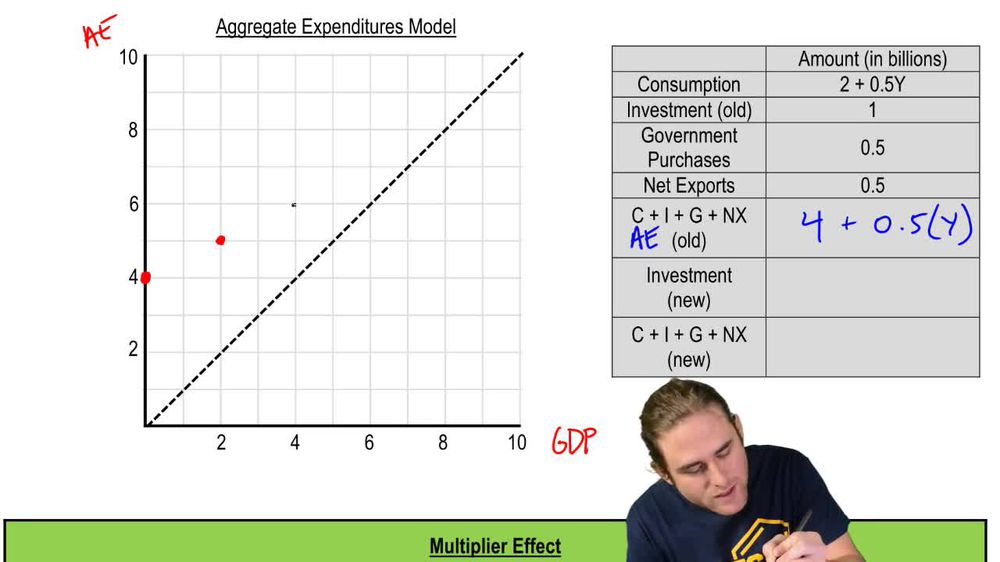
 11:37
11:37