Skip to main content
Microeconomics
My Course
Learn
Exam Prep
AI Tutor
Study Guides
Flashcards
Explore
Try the app
My Course
Learn
Exam Prep
AI Tutor
Study Guides
Flashcards
Explore
Try the app
Back
AE Model: Algebraic Approach definitions
You can tap to flip the card.
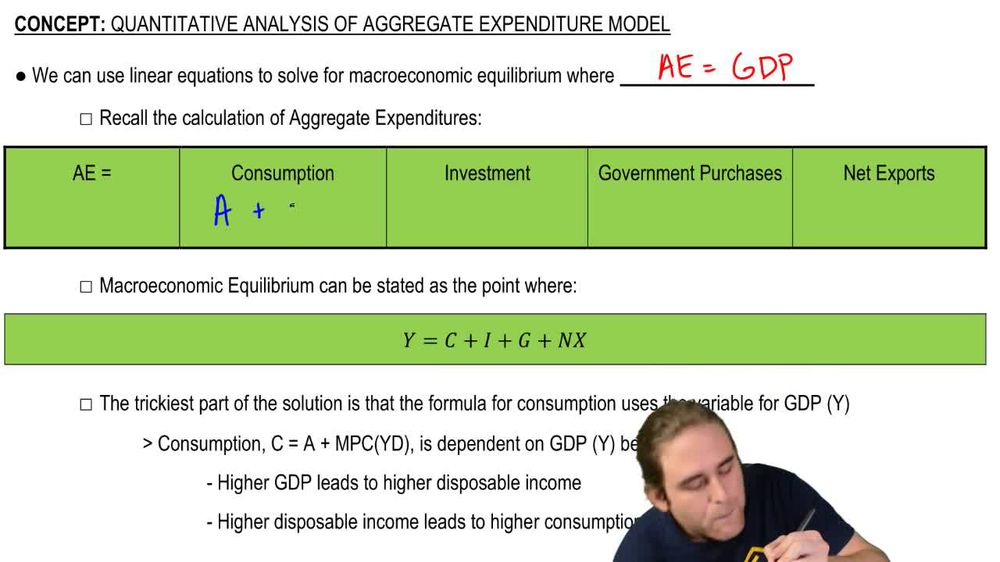
Macroeconomic Equilibrium
You can tap to flip the card.
👆
Macroeconomic Equilibrium
Occurs when total spending in the economy matches the value of goods and services produced, ensuring stability in output.
Track progress
Control buttons has been changed to "navigation" mode.
1/15
Related flashcards
Recommended videos
AE Model: Algebraic Approach quiz
AE Model: Algebraic Approach
15 Terms
Guided course
04:46
Aggregate Expenditures
1
views
Guided course
02:20
Algebraic Approach to the AE Model
1
views
Terms in this set (15)
Hide definitions
Macroeconomic Equilibrium
Occurs when total spending in the economy matches the value of goods and services produced, ensuring stability in output.
Aggregate Expenditures
Represents the sum of spending by households, businesses, government, and foreign buyers on goods and services.
Real GDP
Measures the total value of all final goods and services produced, adjusted for inflation, reflecting economic output.
Consumption
Refers to household spending on goods and services, influenced by income levels and economic conditions.
Disposable Income
Denotes the amount of income available to households after taxes, used for spending or saving.
Marginal Propensity to Consume
Indicates the fraction of additional income that households spend rather than save, shaping consumption patterns.
Market Equilibrium
Describes the point where supply and demand balance, resulting in stable prices and quantities.
Demand Curve
Illustrates the relationship between price and quantity demanded, typically sloping downward.
Economic Profits
Represents the surplus earned after accounting for all costs, including opportunity costs, in production.
Marginal Costs
Reflects the increase in total cost from producing one more unit of output, guiding production decisions.
Market Supply
Shows the total quantity of a good or service that producers are willing to offer at various prices.
Income
Signifies earnings from work, investments, or business, forming the basis for spending and saving.
Linear Equation
Expresses a straight-line relationship between variables, used to model economic interactions algebraically.
Base Consumption
Represents the minimum level of household spending, independent of income, in consumption models.
Aggregate Supply
Captures the total output of goods and services that producers are willing to supply at different price levels.
 BackBack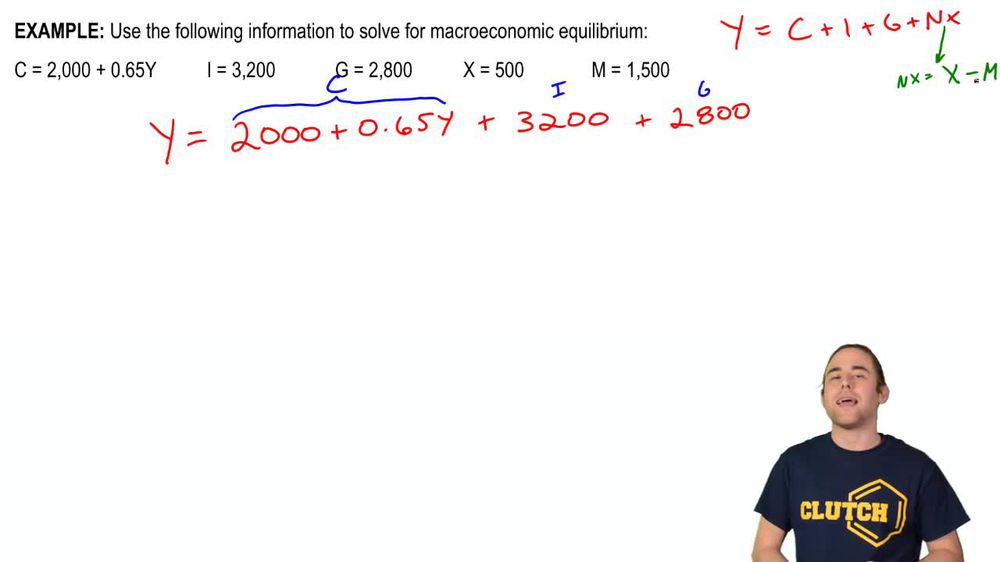
 04:46
04:46