Ch. 5 - Microbial Metabolism
Tortora - Microbiology: An Introduction 14th Edition
Tortora14th EditionMicrobiology: An IntroductionISBN: 9780138200398Not the one you use?Change textbook
Chapter 5, Problem 7

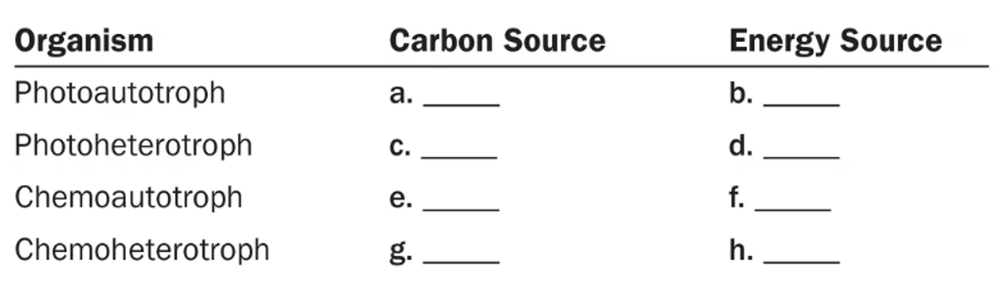
Fill in the following table with the carbon source and energy source of each type of organism.
Table with four organism types and blank spaces to fill in their carbon and energy sources.

Verified step by step guidance
1
Identify the types of organisms listed in the table (e.g., photoautotrophs, chemoheterotrophs, etc.). Each type is classified based on its carbon source and energy source.
Recall the definitions: Carbon source can be either 'CO2' (autotrophs) or 'organic compounds' (heterotrophs). Energy source can be 'light' (phototrophs) or 'chemical compounds' (chemotrophs).
For each organism type, determine the carbon source by deciding if it fixes carbon dioxide (autotroph) or uses organic carbon (heterotroph).
Next, determine the energy source by deciding if the organism uses light energy (phototroph) or chemical energy (chemotroph).
Fill in the table by matching each organism type with its corresponding carbon source and energy source based on the above classifications.

Verified video answer for a similar problem:

This video solution was recommended by our tutors as helpful for the problem above.
Video duration:
2m
Was this helpful?

Key Concepts

Here are the essential concepts you must grasp in order to answer the question correctly.

Metabolic Classification of Organisms

Organisms are classified based on their sources of carbon and energy. This classification helps in understanding how different organisms obtain nutrients and energy for growth and metabolism.
Recommended video:
Guided course
02:17
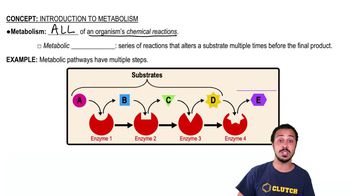
Introduction to Metabolism

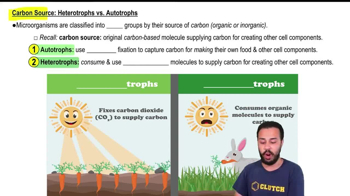
Carbon Sources: Autotrophs vs. Heterotrophs

Autotrophs use inorganic carbon (usually CO2) to build organic molecules, while heterotrophs rely on organic carbon compounds from other organisms. This distinction is fundamental in microbial ecology and metabolism.
Recommended video:
Guided course
02:59
Carbon Source:Heterotrophs vs. Autotrophs

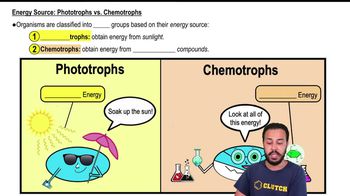
Energy Sources: Phototrophs vs. Chemotrophs

Phototrophs obtain energy from light, whereas chemotrophs derive energy from chemical compounds. Understanding this helps in identifying how organisms harness energy to drive cellular processes.
Recommended video:
Guided course
02:00
Energy Source:Phototrophs vs. Chemotrophs
Related Practice
Textbook Question

All of the energy-producing biochemical reactions that occur in cells, such as photophosphorylation and glycolysis, are ________ reactions.

8
views

Textbook Question

Use the following choices to answer the question.

a. E. coli growing in glucose broth at 35℃ with O2 for 5 days

b. E. coli growing in glucose broth at 35℃ without O2 for 5 days

c. Both a and b

d. Neither a nor b


Which culture produces the most lactic acid?

1
views
Textbook Question

Why must NADH be reoxidized? How does this happen in an organism that uses respiration? Fermentation?

2
views
Textbook Question

Write your own definition of the chemiosmotic mechanism of ATP generation. On Figure 5.16, mark the following using the appropriate letter:

a. The acidic side of the membrane

b. The side with a positive electrical charge

c. Potential energy

d. Kinetic energy

8
views
Textbook Question

Use the following choices to answer the question.

a. E. coli growing in glucose broth at 35℃ with O2 for 5 days

b. E. coli growing in glucose broth at 35℃ without O2 for 5 days

c. Both a and b

d. Neither a nor b


Which culture produces the most ATP?

Textbook Question

Which of the following is the best definition of cellular respiration?

a. A sequence of redox reactions with O2 as the final electron acceptor

b. A sequence of redox reactions with the final electron acceptor from the environment

c. A method of generating ATP

d. The complete oxidation of glucose to CO2 and H2O

e. A series of reactions in which pyruvic acid is oxidized to CO2 and H2O

2
views