
Ch. 2 - Chemical Principles
Tortora - Microbiology: An Introduction 14th Edition
Tortora14th EditionMicrobiology: An IntroductionISBN: 9780138200398Not the one you use?Change textbook
Chapter 2, Problem 1

Radioisotopes are frequently used to label molecules in a cell. The fate of atoms and molecules in a cell can then be followed. This process is the basis for the following question.


Assume E. coli bacteria are grown in a nutrient medium containing the radioisotope 16N. After a 48-hour incubation period, the 16N would most likely be found in the E. coli’s
a. Carbohydrates.
b. Lipids.
c. Proteins.
d. Water.
e. None of the above

Verified step by step guidance
1
Understand the nature of the radioisotope used: ¹⁶N is a radioactive isotope of nitrogen, so it will be incorporated into molecules that contain nitrogen atoms.
Recall the major macromolecules in E. coli and their elemental composition: carbohydrates are primarily composed of carbon, hydrogen, and oxygen; lipids mainly contain carbon, hydrogen, and oxygen; proteins contain carbon, hydrogen, oxygen, and nitrogen; water is H₂O and does not contain nitrogen.
Since ¹⁶N is a nitrogen isotope, it will be incorporated into molecules that contain nitrogen, which in cells are primarily proteins (and nucleic acids, but nucleic acids are not listed here).
Therefore, the ¹⁶N isotope will most likely be found in the proteins of E. coli after incubation in the medium containing ¹⁶N.
Use this reasoning to select the correct answer choice corresponding to proteins.

Verified video answer for a similar problem:

This video solution was recommended by our tutors as helpful for the problem above.
Was this helpful?

Key Concepts

Here are the essential concepts you must grasp in order to answer the question correctly.

Radioisotope Labeling in Cells

Radioisotope labeling involves incorporating radioactive atoms into molecules to trace their path and fate within cells. By using isotopes like ¹⁶N, scientists can track how atoms are utilized in cellular components, helping to identify which biomolecules incorporate specific elements during metabolism.
Recommended video:
Guided course
05:42
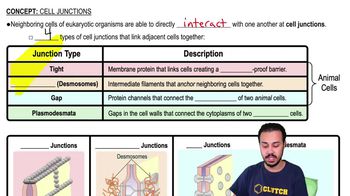
Cell Junctions

Nitrogen in Biomolecules

Nitrogen is a key element found primarily in proteins and nucleic acids, but not in carbohydrates or lipids. Since ¹⁶N is a nitrogen isotope, it will be incorporated mainly into molecules that contain nitrogen atoms, such as amino acids and proteins, rather than molecules like carbohydrates or lipids that lack nitrogen.
Recommended video:
Guided course
01:22
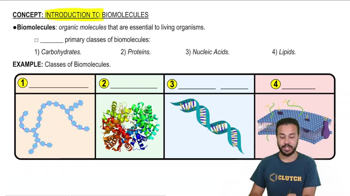
Introduction to Biomolecules

E. coli Metabolism and Biomolecule Synthesis

E. coli synthesizes proteins by incorporating nitrogen from the growth medium into amino acids, which are then assembled into proteins. During incubation with ¹⁶N, the isotope is assimilated into nitrogen-containing compounds, making proteins the most likely cellular component to contain the radioactive nitrogen after 48 hours.
Recommended video:
Guided course
04:12
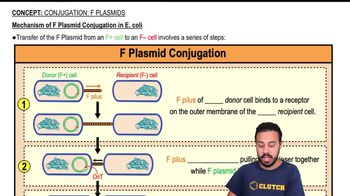
Mechanism of F Plasmid Conjugation in E. coli