
Textbook Question
The best definition of ATP is that it is
a. A molecule stored for food use.
b. A molecule that supplies energy to do work.
c. A molecule stored for an energy reserve.
d. A molecule used as a source of phosphate.
1
views

 Verified step by step guidance
 02:55
02:55
 02:17
02:17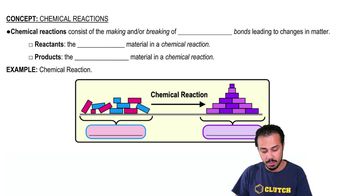 01:56
01:56The best definition of ATP is that it is
a. A molecule stored for food use.
b. A molecule that supplies energy to do work.
c. A molecule stored for an energy reserve.
d. A molecule used as a source of phosphate.
Which of the following is an organic molecule?
a. H2O (water)
b. O2 (oxygen)
c. C18H29SO3
d. FeO (iron oxide)
e. F2C=CF2 (Teflon)
Radioisotopes are frequently used to label molecules in a cell. The fate of atoms and molecules in a cell can then be followed. This process is the basis for the following question.
If E. coli were grown in a medium containing the radioactive isotope 32P, the 32P would be found in all of the following molecules of the cell except
a. ATP.
b. Carbohydrates.
c. DNA.
d. Plasma membrane.
e. Complex lipids.
Classify the following as subunits of either a carbohydrate, lipid, protein, or nucleic acid.
a. <IMAGE>
b. <IMAGE>
c. <IMAGE>
d. Thymine nucleotide
The optimum pH of Acidithiobacillus bacteria (pH 3) is _______________ times more acid than blood (pH 7).
a. 4
b. 10
c. 100
d. 1000
e. 10,000
Classify the following types of chemical reactions.