Name one fungus and one protozoan that can cause genital system infections. What symptoms would lead you to suspect these infections?
Ch. 26 - Microbial Diseases of the Urinary and Reproductive Systems

Tortora14th EditionMicrobiology: An IntroductionISBN: 9780138200398Not the one you use?Change textbook
All textbooks
Tortora 14th Edition
Ch. 26 - Microbial Diseases of the Urinary and Reproductive Systems
Problem 5
Tortora 14th Edition
Ch. 26 - Microbial Diseases of the Urinary and Reproductive Systems
Problem 5Chapter 26, Problem 5
Use the following choices to answer questions 2–5:
a. Candida
b. Chlamydia
c. Gardnerella
d. Neisseria
e. Trichomonas
Microscopic examination of vaginal smear shows gram-negative cocci in phagocytes.
Verified step by step guidance1
Step 1: Identify the key observation in the problem, which is the presence of gram-negative cocci inside phagocytes in a vaginal smear. This indicates that the bacteria are being engulfed by immune cells, suggesting an active infection.
Step 2: Recall the characteristics of the organisms listed: Candida is a fungus, Chlamydia is an obligate intracellular bacterium but not typically seen as gram-negative cocci, Gardnerella is a gram-variable rod, Neisseria is a gram-negative diplococcus, and Trichomonas is a protozoan parasite.
Step 3: Understand that gram-negative cocci inside phagocytes are characteristic of Neisseria species, particularly Neisseria gonorrhoeae, which is known to infect the genital tract and appear as gram-negative diplococci within neutrophils.
Step 4: Use the process of elimination based on morphology and staining: since the problem specifies gram-negative cocci and their presence inside phagocytes, Neisseria is the most appropriate choice.
Step 5: Conclude that the microscopic finding corresponds to Neisseria, which is consistent with the clinical presentation of gonorrhea, a common sexually transmitted infection.

Verified video answer for a similar problem:
This video solution was recommended by our tutors as helpful for the problem above.
Video duration:
2mWas this helpful?
Key Concepts
Here are the essential concepts you must grasp in order to answer the question correctly.
Gram Staining and Bacterial Morphology
Gram staining differentiates bacteria into gram-positive or gram-negative based on their cell wall structure. Gram-negative bacteria appear pink/red under a microscope and have a thin peptidoglycan layer. Cocci are spherical bacteria, and identifying their shape and gram reaction helps narrow down the bacterial species.
Recommended video:
Guided course
Gram Stain
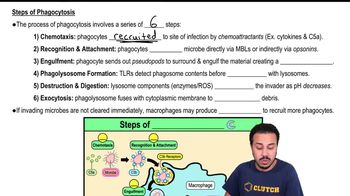
Phagocytosis and Intracellular Bacteria
Phagocytes are immune cells that engulf pathogens. Finding bacteria inside phagocytes indicates the organism can survive or be detected within host immune cells. This helps identify pathogens like Neisseria, which are known to be gram-negative cocci found inside phagocytes in infections.
Recommended video:
Guided course
Steps of Phagocytosis
Common Vaginal Pathogens and Their Characteristics
Different pathogens cause vaginal infections, each with distinct features: Candida is a fungus, Chlamydia is an intracellular bacterium, Gardnerella is a gram-variable rod, Neisseria gonorrhoeae is a gram-negative diplococcus found in phagocytes, and Trichomonas is a protozoan. Recognizing these traits aids in diagnosis.
Recommended video:
Guided course
Introduction to Pathogenic Toxins
Related Practice
Textbook Question
1
views
Textbook Question
Use the following choices to answer questions 2–5:
a. Candida
b. Chlamydia
c. Gardnerella
d. Neisseria
e. Trichomonas
Microscopic examination of vaginal smear shows epithelial cells covered with bacteria.
1
views
Textbook Question
Describe the symptoms of genital herpes. What is the causative agent? When is this infection least likely to be transmitted?
5
views
Textbook Question
Name one organism that causes pyelonephritis. What are the portals of entry for microbes that cause pyelonephritis?
3
views
Textbook Question
Complete the following table
2
views
Textbook Question
Use the following choices to answer the following question:
a. Candidiasis
b. Bacterial vaginosis
c. Genital herpes
d. Lymphogranuloma venereum
e. Trichomoniasis
Difficult to treat with chemotherapy.
2
views