Under what conditions can the saprophytes Aspergillus and Rhizopus cause infections?
Ch. 24 - Microbial Diseases of the Respiratory System

Tortora14th EditionMicrobiology: An IntroductionISBN: 9780138200398Not the one you use?Change textbook
Chapter 24, Problem 3
Your culture from a pneumonia patient appears not to have grown. You do see colonies, however, when the plate is viewed at 100x.
a. Chlamydia
b. Coccidioides
c. Histoplasma
d. Mycobacterium
e. Mycoplasma
Verified step by step guidance1
Step 1: Understand the clinical context and the observation. The culture from a pneumonia patient shows no visible growth to the naked eye, but colonies are visible under 100x magnification. This suggests the organism might be very small or have special growth requirements.
Step 2: Review the characteristics of each organism listed: Chlamydia, Coccidioides, Histoplasma, Mycobacterium, and Mycoplasma. Consider their size, growth patterns, and culture requirements.
Step 3: Recall that Mycoplasma species are among the smallest free-living bacteria and lack a cell wall, making them difficult to see without magnification and often requiring special culture conditions. They often do not form visible colonies to the naked eye but can be seen microscopically.
Step 4: Compare this with other organisms: Coccidioides and Histoplasma are fungi that typically form visible colonies; Mycobacterium grows slowly but usually forms visible colonies; Chlamydia is an obligate intracellular pathogen and does not grow on standard culture media.
Step 5: Conclude that the organism showing colonies only under magnification and not visible to the naked eye is most consistent with Mycoplasma, based on its unique growth characteristics.

Verified video answer for a similar problem:
This video solution was recommended by our tutors as helpful for the problem above.
Video duration:
1mWas this helpful?
Key Concepts
Here are the essential concepts you must grasp in order to answer the question correctly.
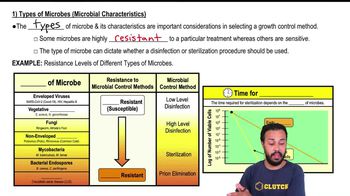
Microbial Growth and Culture Characteristics
Microbial growth on culture media varies by organism; some microbes form visible colonies to the naked eye, while others require magnification or special conditions. Understanding how different pathogens grow helps interpret culture results, especially when colonies are not easily seen but detectable microscopically.
Recommended video:
Guided course
Types of Microbes (Microbial Characteristics)
Unique Features of Atypical Pneumonia Pathogens
Certain pneumonia-causing organisms like Mycoplasma and Chlamydia have unique growth requirements or lack cell walls, making them difficult to culture using standard methods. Recognizing these atypical pathogens is crucial when cultures appear negative despite clinical infection.
Recommended video:
Guided course
Introduction to Pathogenic Toxins
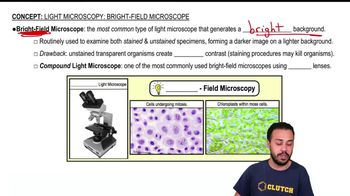
Microscopic Examination in Microbial Identification
Microscopic observation at higher magnifications can reveal microbial colonies or structures not visible to the naked eye. This technique aids in detecting slow-growing or fastidious organisms, guiding diagnosis when routine culture results are inconclusive.
Recommended video:
Guided course
Light Microscopy: Bright-Field Microscopes
Related Practice
Textbook Question
1
views
Textbook Question
The 19 in COVID-19 signifies that
a. this is the 19th coronavirus epidemic.
b. this is 19th known coronavirus.
c. there are 19 strains of Betacoronavirus.
d. the virus was identified in 2019.
e. the symptoms last for 19 days.
1
views
Textbook Question
Match the following choices to the culture descriptions in questions 3 through 6:
a. Chlamydia
b. Coccidioides
c. Histoplasma
d. Mycobacterium
e. Mycoplasma
This pneumonia etiology requires cell culture.
1
views
Textbook Question
Compare and contrast mycoplasmal pneumonia and viral pneumonia.
1
views
Textbook Question
List the causative agent, signs and symptoms, and treatment for four viral diseases of the respiratory system. Separate the diseases according to whether they infect the upper or lower respiratory system.
3
views
Textbook Question
Complete the following table.
<IMAGE>
1
views