


Ch. 23 - Microbial Diseases of the Cardiovascular and Lymphatic Systems
Tortora - Microbiology: An Introduction 14th Edition
Tortora14th EditionMicrobiology: An IntroductionISBN: 9780138200398Not the one you use?Change textbook
Chapter 23, Problem 5

A patient has a red circular rash on his arm and fever, malaise, and joint pain. The most appropriate treatment is
a. Antibiotics.
b. Chloroquine.
c. Anti-inflammatory drugs.
d. Antimony.
e. No treatment.

Verified step by step guidance
1
Step 1: Identify the clinical presentation and possible diagnosis. The patient has a red circular rash, fever, malaise, and joint pain. A red circular rash is characteristic of erythema migrans, which is commonly associated with Lyme disease, a tick-borne illness.
Step 2: Understand the causative agent and pathophysiology. Lyme disease is caused by the bacterium Borrelia burgdorferi, transmitted by Ixodes ticks. The symptoms include rash, systemic signs like fever and malaise, and sometimes joint involvement.
Step 3: Review treatment options for Lyme disease. The standard treatment for early Lyme disease is antibiotics, which target the bacterial infection directly.
Step 4: Evaluate the other options. Chloroquine is an antimalarial drug, antimony compounds are used for leishmaniasis, anti-inflammatory drugs may relieve symptoms but do not treat the infection, and no treatment is inappropriate given the infectious nature.
Step 5: Conclude that the most appropriate treatment is antibiotics to eradicate the bacterial infection and prevent progression.

Verified video answer for a similar problem:

This video solution was recommended by our tutors as helpful for the problem above.
Video duration:
2m
Was this helpful?

Key Concepts

Here are the essential concepts you must grasp in order to answer the question correctly.

Lyme Disease and Its Clinical Presentation

Lyme disease is a tick-borne illness caused by the bacterium Borrelia burgdorferi. A characteristic early sign is a red, circular rash called erythema migrans, often accompanied by fever, malaise, and joint pain. Recognizing these symptoms is crucial for timely diagnosis and treatment.
Recommended video:
Guided course
05:09
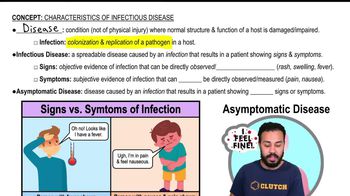
Intro to Characteristics of Infectious Disease

Role of Antibiotics in Treating Bacterial Infections

Antibiotics are drugs used to treat bacterial infections by killing bacteria or inhibiting their growth. Since Lyme disease is caused by bacteria, antibiotics are the most appropriate treatment to eliminate the infection and prevent complications.
Recommended video:
Guided course
03:49
Mechanism of Natural Transformation

Differentiating Treatments Based on Disease Etiology

Different diseases require specific treatments: chloroquine is used for malaria, antimony compounds for leishmaniasis, and anti-inflammatory drugs for symptom relief but not infection control. Understanding the cause of symptoms guides the choice of effective therapy.
Recommended video:
Guided course
03:27
Differential Staining