Ch. 21 - Microbial Diseases of the Skin and Eyes
Tortora - Microbiology: An Introduction 14th Edition
Tortora14th EditionMicrobiology: An IntroductionISBN: 9780138200398Not the one you use?Change textbook
Chapter 21, Problem 8

Use the following choices to answer the question given below.
a. Pseudomonas
b. Staphylococcus aureus
c. Scabies
d. Sporothrix
e. Virus
Microscopic examination of the patient’s ulcer reveals 10μm ovoid cells.

Verified step by step guidance
1
Step 1: Identify the size and shape of the cells observed under the microscope. The problem states the cells are ovoid and approximately 10μm in size.
Step 2: Recall the typical size ranges and shapes of the organisms listed in the choices: Pseudomonas (bacteria, usually smaller than 5μm), Staphylococcus aureus (cocci bacteria, about 1μm), scabies (a mite, much larger than 10μm), Sporothrix (a fungus with yeast-like ovoid cells around 3-10μm), and viruses (much smaller than 1μm).
Step 3: Compare the observed cell size and shape to the known characteristics of each organism. Since the cells are ovoid and about 10μm, this size fits best with fungal yeast cells like Sporothrix.
Step 4: Exclude options that do not match the microscopic features: bacteria and viruses are too small, and scabies is a mite, which is much larger and not described as ovoid cells.
Step 5: Conclude that the microscopic description most likely corresponds to Sporothrix, a dimorphic fungus known to produce ovoid yeast cells of this size in tissue.

Verified video answer for a similar problem:

This video solution was recommended by our tutors as helpful for the problem above.
Video duration:
2m
Was this helpful?

Key Concepts

Here are the essential concepts you must grasp in order to answer the question correctly.

Microscopic Cell Morphology

Understanding the size and shape of cells under the microscope is crucial for identifying microorganisms. Ovoid cells measuring around 10μm suggest a eukaryotic organism, as most bacteria are smaller (1-5μm). This helps differentiate between bacteria, fungi, and other pathogens.
Recommended video:
Guided course
02:44
Types of Bacterial Cell Morphology

Characteristics of Common Pathogens

Familiarity with the typical features of pathogens like Pseudomonas, Staphylococcus aureus, Sporothrix, viruses, and scabies is essential. For example, Sporothrix is a fungus with ovoid yeast cells about 10μm, while bacteria and viruses differ in size and morphology.
Recommended video:
Guided course
03:40
Introduction to Pathogenic Toxins

Diagnostic Relevance of Ulcer Examination

Examining ulcers microscopically helps identify the causative agent by revealing cell type and morphology. This guides diagnosis and treatment, as different pathogens require specific therapies, making microscopic findings a key diagnostic tool.
Recommended video:
Guided course
03:46
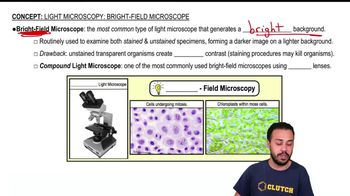
Light Microscopy: Bright-Field Microscopes