A pastry chef accidentally inoculated a cream pie with six S. aureus cells. If S. aureus has a generation time of 60 minutes, how many cells would be in the cream pie after 7 hours?
Ch. 6 - Microbial Growth

Tortora14th EditionMicrobiology: An IntroductionISBN: 9780138200398Not the one you use?Change textbook
Chapter 6, Problem 6.2a
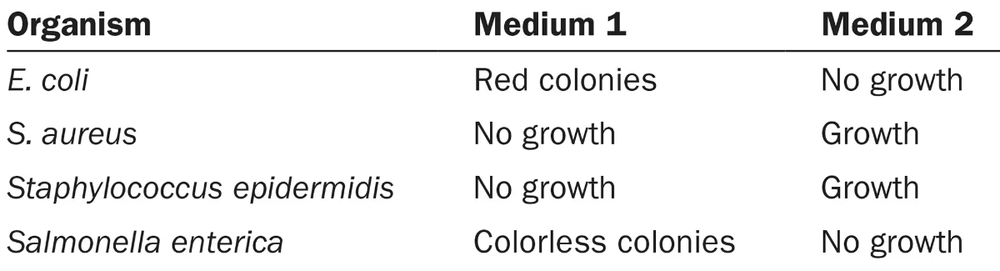
Use the following information to answer questions 1 and 2. Two culture media were inoculated with four different bacteria. After incubation, the following results were obtained:

Medium 2 is:
a. Selective
b. Differential
c. Both selective and differential
Verified step by step guidance1
Step 1: Understand the definitions of selective and differential media. Selective media allow the growth of certain bacteria while inhibiting others. Differential media allow the distinction between different types of bacteria based on their biological characteristics, often indicated by color changes or other visible reactions.
Step 2: Examine the results of bacterial growth on Medium 2. Identify which bacteria grew and which did not. If some bacteria are inhibited, this suggests selectivity.
Step 3: Look for any visible changes in the medium or bacterial colonies on Medium 2 that differentiate between the bacteria that grew. This could be color changes, precipitate formation, or other indicators.
Step 4: Determine if Medium 2 both inhibits certain bacteria (selective) and shows different reactions among the bacteria that grow (differential).
Step 5: Based on your observations, conclude whether Medium 2 is selective, differential, or both selective and differential.

Verified video answer for a similar problem:
This video solution was recommended by our tutors as helpful for the problem above.
Video duration:
1mWas this helpful?
Key Concepts
Here are the essential concepts you must grasp in order to answer the question correctly.
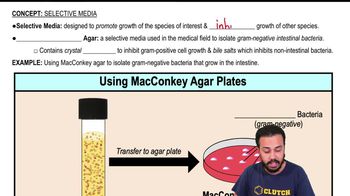
Selective Media
Selective media contain specific agents that inhibit the growth of certain bacteria while allowing others to grow. This property helps isolate particular types of microorganisms from mixed cultures by suppressing unwanted microbes.
Recommended video:
Guided course
Selective Media
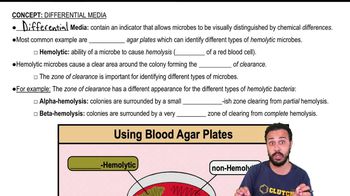
Differential Media
Differential media include indicators that reveal differences between bacterial species based on their metabolic properties. These media allow visible changes, such as color shifts, to distinguish between organisms growing on the same plate.
Recommended video:
Guided course
Differential Media
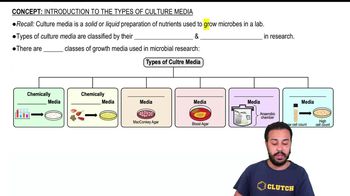
Interpreting Culture Media Results
Analyzing bacterial growth patterns and color changes on culture media helps determine if the medium is selective, differential, or both. Understanding these results requires knowledge of how media components affect bacterial growth and metabolism.
Recommended video:
Guided course
Introduction to the Types of Culture Media
Related Practice
Textbook Question
1
views
Textbook Question
Which one of the following temperatures would most likely kill a mesophile?
a. -50℃
b. 0℃
c. 9℃
d. 37℃
e. 60℃
1
views
Textbook Question
Nitrogen and phosphorus added to beaches following an oil spill encourage the growth of natural oil-degrading bacteria. Explain why the bacteria do not grow if nitrogen and phosphorus are not added.
2
views
Textbook Question
By deep-freezing, bacteria can be stored without harm for extended periods. Why do refrigeration and freezing preserve foods?
1
views
Textbook Question
Differentiate complex and chemically defined media.
1
views
Textbook Question
The term trace elements refers to
a. The elements CHONPS.
b. Vitamins.
c. Nitrogen, phosphorus, and sulfur.
d. Small mineral requirements.
e. Toxic substances.
1
views