Ch. 6 - Microbial Growth
Tortora - Microbiology: An Introduction 14th Edition
Tortora14th EditionMicrobiology: An IntroductionISBN: 9780138200398Not the one you use?Change textbook
Chapter 6, Problem 3

Define and explain the importance of each of the following:
a. Catalase
b. Hydrogen peroxide
c. Peroxidase
d. Superoxide radical
e. Superoxide dismutase

Verified step by step guidance
1
Step 1: Define catalase and explain its importance. Catalase is an enzyme found in nearly all living organisms exposed to oxygen. It catalyzes the decomposition of hydrogen peroxide (H\_2O\_2) into water and oxygen. This is important because hydrogen peroxide is a harmful byproduct of metabolic processes and can cause oxidative damage to cells if not removed efficiently.
Step 2: Define hydrogen peroxide and explain its role. Hydrogen peroxide is a reactive oxygen species (ROS) that is produced as a byproduct of aerobic metabolism. It is toxic to cells because it can generate free radicals that damage proteins, lipids, and DNA. Organisms use enzymes like catalase and peroxidase to neutralize hydrogen peroxide and protect cellular components.
Step 3: Define peroxidase and explain its function. Peroxidase is an enzyme that reduces hydrogen peroxide by using various electron donors, converting it into water. This enzyme helps protect cells from oxidative damage by breaking down hydrogen peroxide, similar to catalase but often with different substrates or in different cellular locations.
Step 4: Define superoxide radical and describe its significance. The superoxide radical (O\_2\(\textsuperscript{\textperiodcentered -}\)) is a reactive oxygen species formed by the one-electron reduction of molecular oxygen. It is highly reactive and can cause damage to cellular components, contributing to oxidative stress. Cells must manage superoxide radicals to maintain cellular health.
Step 5: Define superoxide dismutase (SOD) and explain its role. Superoxide dismutase is an enzyme that catalyzes the conversion of superoxide radicals into oxygen and hydrogen peroxide. This is a critical defense mechanism against oxidative stress, as it reduces the harmful effects of superoxide radicals and provides substrates for catalase and peroxidase to further detoxify hydrogen peroxide.

Verified video answer for a similar problem:

This video solution was recommended by our tutors as helpful for the problem above.
Video duration:
2m
Was this helpful?

Key Concepts

Here are the essential concepts you must grasp in order to answer the question correctly.

Catalase

Catalase is an enzyme found in many organisms that catalyzes the decomposition of hydrogen peroxide into water and oxygen. It protects cells from oxidative damage by breaking down toxic hydrogen peroxide, a byproduct of metabolic processes. Its activity is often used to differentiate bacterial species in microbiology.
Recommended video:

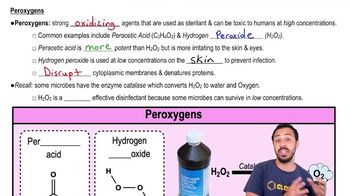
Hydrogen Peroxide

Hydrogen peroxide (H2O2) is a reactive oxygen species produced during cellular metabolism. It is toxic to cells because it can generate free radicals that damage proteins, lipids, and DNA. Organisms use enzymes like catalase and peroxidase to neutralize hydrogen peroxide and prevent oxidative stress.
Recommended video:
Guided course
05:03
Hydrogen Bonding

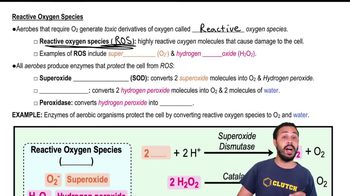
Superoxide Radical and Superoxide Dismutase

The superoxide radical (O2•−) is a highly reactive oxygen species formed during aerobic metabolism. It can cause cellular damage if not controlled. Superoxide dismutase (SOD) is an enzyme that converts superoxide radicals into hydrogen peroxide and oxygen, thus protecting cells from oxidative injury and maintaining cellular health.
Recommended video:
Guided course
04:43
Reactive Oxygen Species