
Ch. 6 - Microbial Growth
Tortora - Microbiology: An Introduction 14th Edition
Tortora14th EditionMicrobiology: An IntroductionISBN: 9780138200398Not the one you use?Change textbook
Chapter 6, Problem 10

An organism that has peroxidase and superoxide dismutase but lacks catalase is most likely an
a. aerobe.
b. aerotolerant anaerobe.
c. obligate anaerobe.

Verified step by step guidance
1
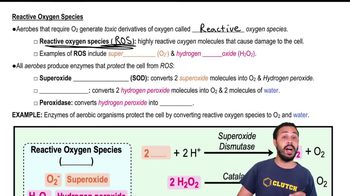
Understand the role of the enzymes mentioned: superoxide dismutase (SOD) converts superoxide radicals into hydrogen peroxide, and peroxidase breaks down hydrogen peroxide into water, but it does not produce oxygen as catalase does.
Recall that catalase is an enzyme that decomposes hydrogen peroxide into water and oxygen, which is important for organisms that live in oxygen-rich environments to protect themselves from oxidative damage.
Analyze the presence of superoxide dismutase and peroxidase but the absence of catalase: this suggests the organism can handle some reactive oxygen species but does not produce oxygen from hydrogen peroxide, indicating a specific oxygen tolerance.
Match these enzyme characteristics to the types of oxygen requirements: obligate aerobes have catalase and SOD, obligate anaerobes lack both, and aerotolerant anaerobes have SOD and peroxidase but lack catalase.
Conclude that an organism with peroxidase and superoxide dismutase but lacking catalase is most likely an aerotolerant anaerobe, which tolerates oxygen but does not use it for growth.

Verified video answer for a similar problem:

This video solution was recommended by our tutors as helpful for the problem above.
Video duration:
2m
Was this helpful?

Key Concepts

Here are the essential concepts you must grasp in order to answer the question correctly.

Role of Peroxidase and Superoxide Dismutase in Oxygen Metabolism

Peroxidase and superoxide dismutase are enzymes that help detoxify reactive oxygen species (ROS). Superoxide dismutase converts superoxide radicals into hydrogen peroxide, while peroxidase breaks down hydrogen peroxide into water, protecting cells from oxidative damage.
Recommended video:
Guided course
04:43
Reactive Oxygen Species

Function of Catalase in Aerobic Organisms

Catalase is an enzyme that rapidly decomposes hydrogen peroxide into water and oxygen. Its presence is typical in aerobes that encounter high levels of oxygen, helping them survive oxidative stress by efficiently removing hydrogen peroxide.
Recommended video:
Guided course
06:04
Functional Groups

Classification of Organisms Based on Oxygen Requirements

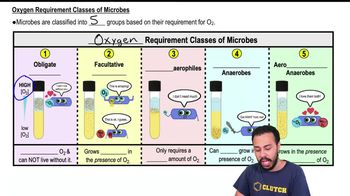
Organisms are classified by their oxygen tolerance: aerobes require oxygen, obligate anaerobes are harmed by oxygen, and aerotolerant anaerobes do not use oxygen but can survive in its presence, often possessing enzymes like peroxidase and superoxide dismutase but lacking catalase.
Recommended video:
Guided course
07:27
Oxygen Requirement Classes of Microbes