Ch. 5 - Genetics
Norman-McKay- Microbiology: Basic and Clinical Principles 2nd Edition
Norman-McKay2nd EditionMicrobiology: Basic and Clinical PrinciplesISBN: 9780137661619Not the one you use?Change textbook
Chapter 5, Problem 8

Label the following as a biological, chemical, or physical mutagen:
UV radiation:
Transposons:
Cigarette smoke:
Viruses:
X-rays:
Plasmids:
Alcohol:

Verified step by step guidance
1
Understand the definitions of the three types of mutagens: Biological mutagens are living organisms or their products that cause mutations (e.g., viruses, transposons, plasmids). Chemical mutagens are substances that chemically alter DNA, leading to mutations (e.g., cigarette smoke, alcohol). Physical mutagens are physical agents that cause DNA damage through energy exposure (e.g., UV radiation, X-rays).
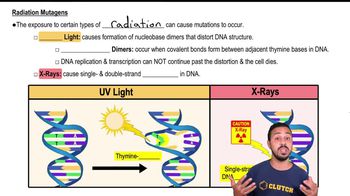
Analyze each item in the list and classify it based on the definitions: UV radiation is a form of electromagnetic radiation that causes DNA damage by inducing thymine dimers, so it is a physical mutagen.
Transposons are DNA sequences that can move within the genome, causing mutations by insertion or excision, and are considered biological mutagens because they are genetic elements within organisms.
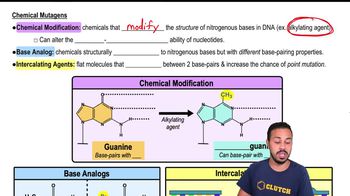
Cigarette smoke contains many chemical compounds that can interact with DNA and cause mutations, so it is classified as a chemical mutagen.
Viruses can insert their genetic material into host DNA, disrupting normal function and causing mutations, making them biological mutagens.
X-rays are high-energy radiation that can break DNA strands, so they are physical mutagens.
Plasmids are small, circular DNA molecules in bacteria that can carry genes and sometimes cause mutations when transferred, so they are biological mutagens.
Alcohol can cause mutations indirectly by generating reactive oxygen species and interfering with DNA repair, classifying it as a chemical mutagen.

Verified video answer for a similar problem:

This video solution was recommended by our tutors as helpful for the problem above.
Video duration:
1m
Was this helpful?

Key Concepts

Here are the essential concepts you must grasp in order to answer the question correctly.

Types of Mutagens

Mutagens are agents that cause changes or mutations in the DNA sequence. They are classified into biological (living organisms or their products), chemical (substances that interact chemically with DNA), and physical mutagens (forms of radiation or physical energy). Understanding these categories helps in identifying the nature of different mutagenic agents.
Recommended video:
Guided course
02:55
Radiation Mutagens

Physical Mutagens

Physical mutagens include forms of radiation such as UV light and X-rays that cause DNA damage by inducing breaks or chemical changes in the DNA structure. These mutagens alter the DNA through energy transfer, leading to mutations like thymine dimers or strand breaks.
Recommended video:
Guided course
02:55
Radiation Mutagens

Biological and Chemical Mutagens

Biological mutagens include entities like viruses, transposons, and plasmids that can insert or alter genetic material within a host. Chemical mutagens, such as cigarette smoke and alcohol, contain compounds that chemically modify DNA bases or cause replication errors, leading to mutations.
Recommended video:
Guided course
05:13
Chemical Mutagens