Ch. 7 - Fundamentals of Microbial Growth
Norman-McKay- Microbiology: Basic and Clinical Principles 2nd Edition
Norman-McKay2nd EditionMicrobiology: Basic and Clinical PrinciplesISBN: 9780137661619Not the one you use?Change textbook
Chapter 7, Problem 2

If a bacterium that normally lives in the gastrointestinal tract is plunged into a salty solution, what would occur?
a. Halophilic adjustment
b. Osmotic concentration
c. Lysis
d. Plasmolysis
e. Nothing

Verified step by step guidance
1
Step 1: Understand the environment change — the bacterium is moved from its normal gastrointestinal tract environment to a salty (hypertonic) solution, which means the external solute concentration is higher than inside the bacterial cell.
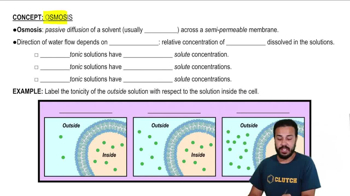
Step 2: Recall the concept of osmosis — water moves across a semipermeable membrane from an area of lower solute concentration to an area of higher solute concentration to balance solute levels.
Step 3: Predict water movement — in a salty solution, water will move out of the bacterial cell into the surrounding solution, causing the cell to lose water.
Step 4: Identify the cellular response — loss of water causes the cytoplasm to shrink away from the cell wall, a process known as plasmolysis.
Step 5: Match the correct term — among the options, plasmolysis (option d) correctly describes the effect of placing a bacterium in a hypertonic salty solution.

Verified video answer for a similar problem:

This video solution was recommended by our tutors as helpful for the problem above.
Video duration:
3m
Was this helpful?

Key Concepts

Here are the essential concepts you must grasp in order to answer the question correctly.

Osmosis and Water Movement

Osmosis is the movement of water across a semipermeable membrane from an area of low solute concentration to high solute concentration. In bacteria, water moves to balance solute differences between the inside of the cell and its environment, affecting cell volume and pressure.
Recommended video:

Plasmolysis in Bacteria

Plasmolysis occurs when a bacterial cell is placed in a hypertonic (salty) solution, causing water to leave the cell. This results in the cell membrane pulling away from the cell wall, leading to cell shrinkage and impaired function.
Recommended video:
Guided course
06:18
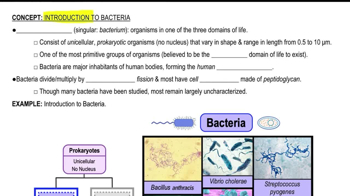
Introduction to Bacteria

Halophilic Adaptation

Halophilic bacteria are adapted to live in high-salt environments by maintaining internal solute concentrations to prevent water loss. Non-halophilic bacteria, when exposed to salty solutions, cannot adjust quickly, leading to osmotic stress.
Recommended video:
Guided course
05:47
Introduction to Adaptive Immunity