Ch. 4 - Introduction to Eukaryotic Cells
Norman-McKay- Microbiology: Basic and Clinical Principles 2nd Edition
Norman-McKay2nd EditionMicrobiology: Basic and Clinical PrinciplesISBN: 9780137661619Not the one you use?Change textbook
Chapter 4, Problem 8

The presence of which of the following would be helpful in distinguishing a prokaryote from a eukaryote? Select all that apply.
a. Peptidoglycan
b. Phospholipids
c. A cell wall
d. A nucleus
e. Chloroplasts
f. Ribosomes
g. Ability to carry out active transport
h. DNA

Verified step by step guidance
1
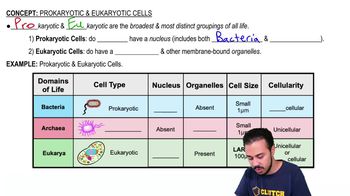
Step 1: Understand the fundamental differences between prokaryotes and eukaryotes. Prokaryotes are simpler cells without a nucleus or membrane-bound organelles, while eukaryotes have a nucleus and organelles like chloroplasts.
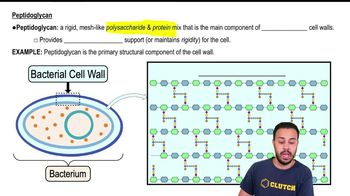
Step 2: Identify features unique to prokaryotes. For example, peptidoglycan is a component of bacterial cell walls, which are prokaryotic, but not found in eukaryotic cells.
Step 3: Recognize features unique to eukaryotes. The presence of a nucleus and chloroplasts are hallmark characteristics of eukaryotic cells.
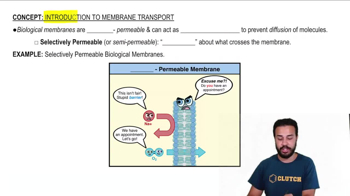
Step 4: Evaluate common features that do not distinguish between the two, such as phospholipids (both have membranes), ribosomes (both have them, though structurally different), DNA (both have genetic material), and the ability to carry out active transport (both can do this).
Step 5: Based on this analysis, select all options that are distinctive markers for either prokaryotes or eukaryotes to effectively distinguish between them.

Verified video answer for a similar problem:

This video solution was recommended by our tutors as helpful for the problem above.
Video duration:
2m
Was this helpful?

Key Concepts

Here are the essential concepts you must grasp in order to answer the question correctly.

Cellular Structure Differences Between Prokaryotes and Eukaryotes

Prokaryotes lack membrane-bound organelles such as a nucleus and chloroplasts, which are present in eukaryotes. This fundamental difference helps distinguish the two cell types, as prokaryotes have a simpler internal structure without compartmentalization.
Recommended video:
Guided course
05:54
Prokaryotic & Eukaryotic Cells

Presence of Peptidoglycan in Cell Walls

Peptidoglycan is a unique component of bacterial cell walls, found only in prokaryotes. Eukaryotic cells, if they have cell walls, do not contain peptidoglycan, making it a key marker for identifying prokaryotic cells.
Recommended video:
Guided course
01:58
Peptidoglycan

Membrane Components and Transport Mechanisms

Both prokaryotes and eukaryotes have phospholipid membranes and ribosomes, and both can perform active transport. These features are not useful for distinguishing between the two, as they are common to both cell types.
Recommended video:
Guided course
02:47
Introduction to Membrane Transport