
Ch. 4 - Introduction to Eukaryotic Cells
Norman-McKay- Microbiology: Basic and Clinical Principles 2nd Edition
Norman-McKay2nd EditionMicrobiology: Basic and Clinical PrinciplesISBN: 9780137661619Not the one you use?Change textbook
Chapter 4, Problem 12

Fungal spores can be made by ________. Select all that apply.
a. Binary fission
b. Mitosis
c. Meiosis
d. Asexual reproduction
e. Sexual reproduction
f. Sporogony

Verified step by step guidance
1
Step 1: Understand that fungal spores are reproductive units produced by fungi, which can arise through different reproductive processes.
Step 2: Recognize that fungal spores can be produced by asexual reproduction, which often involves mitosis, leading to genetically identical spores.
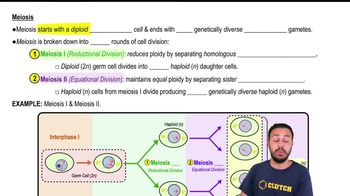
Step 3: Note that fungal spores can also be produced by sexual reproduction, which involves meiosis, resulting in genetically diverse spores.
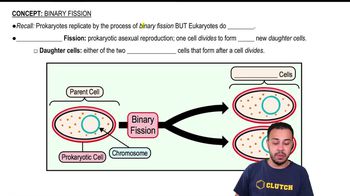
Step 4: Identify that binary fission is a form of asexual reproduction typical of prokaryotes like bacteria, not fungi, so it does not apply here.
Step 5: Understand that sporogony is a specific type of spore formation seen in some protozoa (like Plasmodium), not fungi, so it is not applicable to fungal spore formation.

Verified video answer for a similar problem:

This video solution was recommended by our tutors as helpful for the problem above.
Video duration:
2m
Was this helpful?

Key Concepts

Here are the essential concepts you must grasp in order to answer the question correctly.

Fungal Reproduction Methods

Fungi reproduce through both sexual and asexual means, producing spores as reproductive units. Asexual reproduction involves mitosis to create genetically identical spores, while sexual reproduction involves meiosis, generating genetic diversity. Understanding these methods is key to identifying how fungal spores are formed.
Recommended video:
Guided course
06:29
Scientific Method

Mitosis and Meiosis in Spore Formation

Mitosis is a type of cell division producing two identical daughter cells, commonly involved in asexual spore formation. Meiosis, on the other hand, reduces chromosome number by half, producing genetically diverse spores during sexual reproduction. Both processes are fundamental to fungal spore generation.
Recommended video:

Sporogony and Binary Fission

Sporogony is a specialized form of spore formation seen in some parasites, not typically fungi. Binary fission is a simple cell division method common in prokaryotes, not fungi. Recognizing these distinctions helps exclude incorrect options related to fungal spore production.
Recommended video:
Guided course
02:16
Binary Fission