Ch. 19 - Digestive System Infections
Norman-McKay- Microbiology: Basic and Clinical Principles 2nd Edition
Norman-McKay2nd EditionMicrobiology: Basic and Clinical PrinciplesISBN: 9780137661619Not the one you use?Change textbook
Chapter 19, Problem 19

A lower endoscopy examination of a patient complaining of abdominal cramps and diarrhea reveals pus-laden patches along the intestinal wall. Which of the following infectious agents could be considered the pathogen responsible for this condition?
a. Clostridioides difficile
b. Shigella
c. Salmonella serotype Typhi
d. Helicobacter pylori
e. Campylobacter jejuni

Verified step by step guidance
1
Step 1: Understand the clinical presentation described: the patient has abdominal cramps and diarrhea, and the lower endoscopy shows pus-laden patches along the intestinal wall. This suggests an inflammatory process with mucosal damage and pus formation, indicating an invasive or toxin-mediated infection.
Step 2: Review the characteristics of each listed pathogen in relation to intestinal infections: Clostridioides difficile typically causes pseudomembranous colitis with characteristic plaques, Shigella causes invasive colitis with mucosal ulceration and pus, Salmonella Typhi causes typhoid fever with systemic symptoms and less mucosal pus, Helicobacter pylori primarily infects the stomach causing gastritis and ulcers, and Campylobacter jejuni causes enteritis with inflammation but usually not pus-laden patches visible on endoscopy.
Step 3: Focus on the pathogens that cause invasive colitis with pus formation: Shigella is well-known for causing dysentery characterized by bloody diarrhea and pus due to mucosal invasion and destruction, which matches the endoscopic findings.
Step 4: Exclude pathogens less likely to cause pus-laden patches in the colon: Clostridioides difficile causes pseudomembranes rather than pus patches, Salmonella Typhi affects the ileum and systemic organs more than causing pus patches, Helicobacter pylori affects the stomach, and Campylobacter jejuni causes inflammation but not typically pus-laden patches visible on endoscopy.
Step 5: Conclude that the most likely pathogen responsible for pus-laden patches along the intestinal wall in a patient with abdominal cramps and diarrhea is Shigella, based on its invasive nature and characteristic mucosal damage.

Verified video answer for a similar problem:

This video solution was recommended by our tutors as helpful for the problem above.
Video duration:
2m
Was this helpful?

Key Concepts

Here are the essential concepts you must grasp in order to answer the question correctly.

Pathogenesis of Intestinal Infections

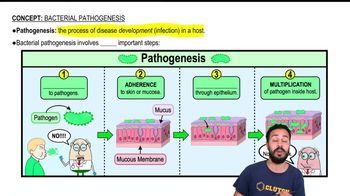
Understanding how different bacteria cause intestinal disease is crucial. Some pathogens invade the intestinal mucosa causing inflammation and pus formation, while others produce toxins without direct invasion. Recognizing the mechanism helps link clinical findings like pus-laden patches to specific bacteria.
Recommended video:
Guided course
02:35
Intro to Bacterial Pathogenesis

Clinical Presentation of Bacterial Gastroenteritis

Different bacterial infections present with distinct symptoms such as diarrhea, abdominal cramps, and sometimes bloody stools. Identifying characteristic signs, like the presence of pus or ulceration seen in endoscopy, aids in narrowing down the causative agent among common enteric pathogens.
Recommended video:
Guided course
03:06
Bacterial Transformation

Characteristics of Common Enteric Pathogens

Familiarity with the typical features of bacteria like Clostridioides difficile, Shigella, Salmonella Typhi, Helicobacter pylori, and Campylobacter jejuni is essential. For example, Shigella is known for causing invasive colitis with mucosal ulceration and pus, which matches the endoscopic findings described.
Recommended video:
Guided course
03:40
Introduction to Pathogenic Toxins