
Ch. 13 - Immune System Disorders
Norman-McKay- Microbiology: Basic and Clinical Principles 2nd Edition
Norman-McKay2nd EditionMicrobiology: Basic and Clinical PrinciplesISBN: 9780137661619Not the one you use?Change textbook
Chapter 13, Problem 13

Which types of white blood cells are most likely to be involved in type I hypersensitivities? Select all that apply.
a. T helper cells
b. T cytotoxic cells
c. Basophils
d. Macrophages
e. Mast cells

Verified step by step guidance
1
Understand that type I hypersensitivity reactions are immediate allergic reactions mediated primarily by IgE antibodies.
Recall that IgE antibodies bind to receptors on certain white blood cells, which then release histamine and other mediators causing allergy symptoms.
Identify the white blood cells that have high-affinity IgE receptors: these are primarily mast cells and basophils.
Recognize that T helper cells (specifically Th2 cells) play a role in stimulating B cells to produce IgE, but they are not the effector cells releasing histamine.
Conclude that the main white blood cells involved in the effector phase of type I hypersensitivity are mast cells and basophils.

Verified video answer for a similar problem:

This video solution was recommended by our tutors as helpful for the problem above.
Video duration:
1m
Was this helpful?

Key Concepts

Here are the essential concepts you must grasp in order to answer the question correctly.

Type I Hypersensitivity

Type I hypersensitivity is an immediate allergic reaction mediated by IgE antibodies. It involves the rapid activation of immune cells upon exposure to an allergen, leading to symptoms like inflammation, itching, and swelling. Understanding this mechanism is key to identifying the cells involved.
Recommended video:
Guided course
01:06
Types of Phosphorylation

Role of Mast Cells

Mast cells are tissue-resident immune cells that play a central role in type I hypersensitivity. They have high-affinity IgE receptors and release histamine and other mediators upon allergen binding, causing allergic symptoms such as vasodilation and bronchoconstriction.
Recommended video:
Guided course
03:53
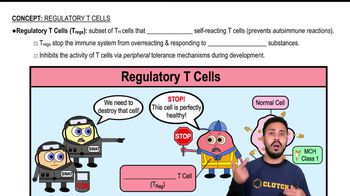
Regulatory T Cells

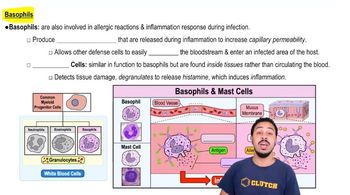
Role of Basophils

Basophils are circulating white blood cells similar to mast cells that also express IgE receptors. They contribute to type I hypersensitivity by releasing histamine and inflammatory mediators during allergic reactions, amplifying the immune response.
Recommended video:
Related Practice
Textbook Question

Which of the following is (are) true regarding primary immunodeficiencies? Select all that apply.

a. These disorders tend to be present from birth.

b. These disorders are also called congenital immunodeficiencies.

c. These disorders are more common in elderly patients.

d. Patients with these disorders may not have a familial history of immunodeficiencies.

e. Patients with these disorders tend to experience recurring, persistent, and severe infections, often caused by uncommon agents.

1
views
Textbook Question

Which of the following is (are) true regarding type III hypersensitivity reactions? Select all that apply.

a. They involve IgG

b. They involve IgM

c. They are considered delayed reactions

d. They include autoimmune disorders like multiple sclerosis

e. They are rare compared with type I reactions

Textbook Question

Which of the following is the most likely to lead to graft-versushost disease?

a. An allogeneic bone marrow transplant

b. An allogeneic liver transplant

c. A xenogeneic heart valve transplant

d. An isogenic bone marrow transplant

e. A xenogeneic skin graft

1
views
Textbook Question

What is the general goal of treatments used for autoimmune disorders?

7
views
Textbook Question

Imagine that one of your patients is an emergency medical technician who has a family history of autoimmune disorders and allergy, but she does not currently suffer from either. Which of the following is (are) most likely true of your patient? Select all that apply.

a. She is at an increased risk for cancer

b. She is at an increased risk for type I hypersensitivities

c. She is at an increased risk for type III hypersensitivities

d. She is at an increased risk for latex hypersensitivity

e. She is at an increased risk for immunosuppression

11
views