Ch. 12 - Adaptive Immunity
Norman-McKay- Microbiology: Basic and Clinical Principles 2nd Edition
Norman-McKay2nd EditionMicrobiology: Basic and Clinical PrinciplesISBN: 9780137661619Not the one you use?Change textbook
Chapter 12, Problem 13

The distinct feature of an antigen that stimulates an adaptive immune response is called a(n) ________________.

Verified step by step guidance
1
Understand that the question is asking for the specific term used to describe the part of an antigen that is recognized by the adaptive immune system.
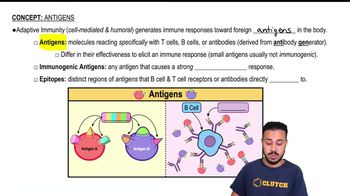
Recall that antigens are molecules capable of inducing an immune response, but the immune system specifically recognizes certain small regions on these molecules.
Identify that these specific regions on the antigen that are recognized by immune cells (like B cells and T cells) are called epitopes.
Note that epitopes are the distinct features or sites on the antigen that bind to receptors on lymphocytes, triggering the adaptive immune response.
Conclude that the correct term to fill in the blank is 'epitope', which is the key concept in understanding antigen recognition in adaptive immunity.

Verified video answer for a similar problem:

This video solution was recommended by our tutors as helpful for the problem above.
Video duration:
1m
Was this helpful?

Key Concepts

Here are the essential concepts you must grasp in order to answer the question correctly.

Antigen

An antigen is any molecule or molecular structure, often a protein or polysaccharide, that is recognized by the immune system as foreign. Antigens trigger an immune response, particularly by adaptive immunity, which targets specific pathogens or infected cells.
Recommended video:

Epitope

An epitope, also known as an antigenic determinant, is the specific part of an antigen that is recognized and bound by an antibody or a receptor on a T-cell. It is the precise molecular feature that stimulates the adaptive immune response.
Recommended video:

Adaptive Immune Response

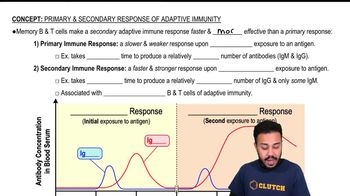
The adaptive immune response is a targeted defense mechanism that develops after exposure to a specific antigen. It involves lymphocytes like B cells and T cells, which recognize epitopes and generate memory for faster response upon re-exposure.
Recommended video:
Guided course
06:59
Primary and Secondary Response of Adaptive Immunity