Ch. 12 - Adaptive Immunity
Norman-McKay- Microbiology: Basic and Clinical Principles 2nd Edition
Norman-McKay2nd EditionMicrobiology: Basic and Clinical PrinciplesISBN: 9780137661619Not the one you use?Change textbook
Chapter 12, Problem 19a

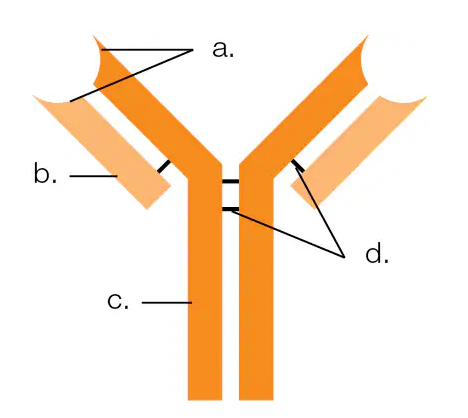
Label the indicated parts of the antibody.
Diagram of an antibody molecule with labeled regions indicating variable and constant segments of heavy and light chains.

Verified step by step guidance
1
Understand the basic structure of an antibody (immunoglobulin), which typically consists of two heavy chains and two light chains forming a Y-shaped molecule.
Identify the Fab region (Fragment antigen-binding), which includes the variable regions of both the heavy and light chains and is responsible for antigen recognition and binding.
Locate the Fc region (Fragment crystallizable), which is the stem of the Y-shaped antibody and interacts with cell receptors and complement proteins to mediate immune responses.
Distinguish the variable (V) regions at the tips of the Fab arms, which provide antigen specificity, from the constant (C) regions that provide structural stability and effector functions.
Label the hinge region, which connects the Fab arms to the Fc region and provides flexibility to the antibody molecule, allowing it to bind antigens effectively.

Verified video answer for a similar problem:

This video solution was recommended by our tutors as helpful for the problem above.
Video duration:
1m
Was this helpful?

Key Concepts

Here are the essential concepts you must grasp in order to answer the question correctly.

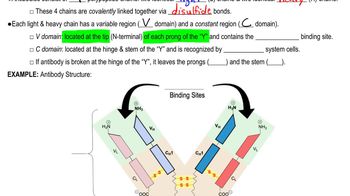
Antibody Structure

Antibodies, or immunoglobulins, are Y-shaped proteins composed of two heavy chains and two light chains. Each chain has constant and variable regions, with the variable regions forming the antigen-binding sites. Understanding this structure is essential for identifying antibody parts.
Recommended video:
Guided course
05:40
Antibody Structure

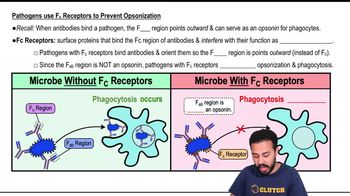
Fab and Fc Regions

The antibody is divided into Fab (Fragment antigen-binding) and Fc (Fragment crystallizable) regions. The Fab region contains the variable domains that bind antigens, while the Fc region mediates immune effector functions by interacting with cell receptors and complement proteins.
Recommended video:
Guided course
03:48
Pathogens Use Fc Receptors to Prevent Opsonization

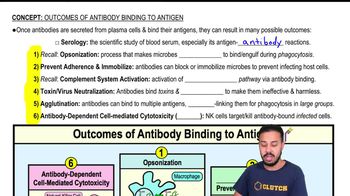
Antigen-Binding Sites

Antigen-binding sites are located at the tips of the Fab regions and are formed by the variable domains of both heavy and light chains. These sites specifically recognize and bind to unique epitopes on antigens, enabling the immune system to target pathogens precisely.
Recommended video:
Guided course
09:16
Outcomes of Antibody Binding to Antigen