Ch. 11 - Innate Immunity
Norman-McKay- Microbiology: Basic and Clinical Principles 2nd Edition
Norman-McKay2nd EditionMicrobiology: Basic and Clinical PrinciplesISBN: 9780137661619Not the one you use?Change textbook
Chapter 11, Problem 11

Which of the following is not a feature of innate immunity?
a. Better protection upon later exposure to a given pathogen
b. Recognition of diverse pathogens
c. Discrimination between self and foreign
d. Killing of identified invaders
e. Stimulation of adaptive immunity

Verified step by step guidance
1
Step 1: Understand the definition of innate immunity. Innate immunity is the body's first line of defense against pathogens and is characterized by immediate, non-specific responses to a wide range of invaders.
Step 2: Review each option in the context of innate immunity features. Innate immunity typically includes recognition of diverse pathogens, discrimination between self and foreign cells, killing of identified invaders, and stimulation of adaptive immunity.
Step 3: Identify the feature that does not belong to innate immunity. Innate immunity does not improve or provide better protection upon later exposure to the same pathogen; this is a hallmark of adaptive immunity, which has memory.
Step 4: Conclude that the option describing 'better protection upon later exposure to a given pathogen' is not a feature of innate immunity because it describes immunological memory, a property of adaptive immunity.
Step 5: Summarize that innate immunity is immediate and non-specific, while adaptive immunity is specific and improves upon repeated exposure to the same pathogen.

Verified video answer for a similar problem:

This video solution was recommended by our tutors as helpful for the problem above.
Video duration:
2m
Was this helpful?

Key Concepts

Here are the essential concepts you must grasp in order to answer the question correctly.

Innate Immunity Characteristics

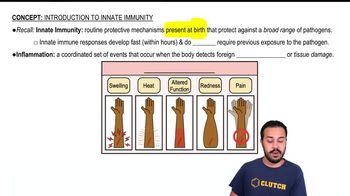
Innate immunity is the body's first line of defense, providing immediate, non-specific protection against pathogens. It recognizes common molecular patterns on microbes but does not improve upon repeated exposures. Key features include rapid response, broad pathogen recognition, and activation of other immune components.
Recommended video:
Guided course
02:30
Introduction to Innate Immunity

Adaptive Immunity and Memory

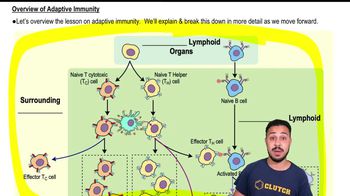
Adaptive immunity is a specific immune response that develops over time and improves with repeated exposure to the same pathogen. It involves memory cells that provide better protection upon subsequent encounters, distinguishing it from innate immunity's non-specific and non-memory-based response.
Recommended video:
Guided course
04:57
Overview of Adaptive Immunity

Self vs. Non-Self Discrimination

Both innate and adaptive immunity can distinguish between the body's own cells (self) and foreign invaders (non-self). This discrimination prevents the immune system from attacking the body's own tissues while targeting pathogens for destruction.
Recommended video:
Guided course
02:06
Cyclic vs. Non-Cyclic Photophosphorylation