Ch. 9 - Controlling Microbial Growth in the Environment
Bauman - Microbiology with Diseases by Taxonomy 6th Edition
Bauman6th EditionMicrobiology with Diseases by TaxonomyISBN: 9780134832302Not the one you use?Change textbook
Chapter 9, Problem 5

Why are Gram-negative bacteria more susceptible to heat than Gram-positive bacteria?

Verified step by step guidance
1
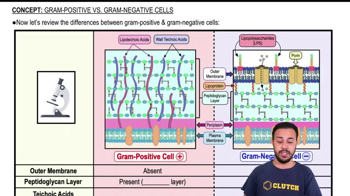
Understand the structural differences between Gram-positive and Gram-negative bacteria, focusing on their cell wall composition.
Recall that Gram-positive bacteria have a thick peptidoglycan layer, which provides rigidity and protection against environmental stresses such as heat.
Note that Gram-negative bacteria have a thinner peptidoglycan layer but possess an outer membrane containing lipopolysaccharides, which is less protective against heat.
Analyze how the thick peptidoglycan layer in Gram-positive bacteria acts as a thermal barrier, helping to maintain cell integrity under heat stress.
Conclude that the thinner peptidoglycan layer and the presence of the outer membrane in Gram-negative bacteria make them more vulnerable to heat-induced damage, leading to higher susceptibility.

Verified video answer for a similar problem:

This video solution was recommended by our tutors as helpful for the problem above.
Video duration:
2m
Was this helpful?

Key Concepts

Here are the essential concepts you must grasp in order to answer the question correctly.

Cell Wall Structure of Gram-Positive and Gram-Negative Bacteria

Gram-positive bacteria have a thick peptidoglycan layer that provides structural strength and protection, while Gram-negative bacteria have a thinner peptidoglycan layer and an outer membrane. This difference affects their resilience to environmental stresses like heat.
Recommended video:
Guided course
04:46
Gram-Positive vs. Gram-Negative Cell Walls

Role of the Outer Membrane in Gram-Negative Bacteria

The outer membrane of Gram-negative bacteria contains lipopolysaccharides and acts as a barrier to certain substances, but it is more sensitive to heat damage. Heat can disrupt this membrane, making Gram-negative bacteria more vulnerable compared to Gram-positive bacteria.
Recommended video:
Guided course
02:15
The Outer Membrane

Heat Denaturation of Proteins and Membrane Integrity

Heat causes proteins to denature and membranes to lose integrity, leading to cell death. Since Gram-negative bacteria have a more complex and delicate outer membrane, heat-induced damage compromises their survival more readily than the robust cell wall of Gram-positive bacteria.
Recommended video:
Guided course
04:00
Denatured Proteins & Chaperones