Ch. 9 - Controlling Microbial Growth in the Environment
Bauman - Microbiology with Diseases by Taxonomy 6th Edition
Bauman6th EditionMicrobiology with Diseases by TaxonomyISBN: 9780134832302Not the one you use?Change textbook
Chapter 9, Problem 3

Which of the following terms best describes the disinfecting of cafeteria plates?
a. Pasteurization
b. Antisepsis
c. Sterilization
d. Sanitization

Verified step by step guidance
1
Step 1: Understand the definitions of each term to identify which best fits the context of disinfecting cafeteria plates.
Step 2: Pasteurization is a process that uses mild heat to reduce the number of pathogens in liquids like milk, but it is not typically used for solid objects like plates.
Step 3: Antisepsis refers to the use of chemical agents on living tissues (like skin) to reduce or eliminate microbes, so it is not appropriate for inanimate objects such as plates.
Step 4: Sterilization is the complete elimination or destruction of all forms of microbial life, including spores, which is often more rigorous than necessary for cafeteria plates.
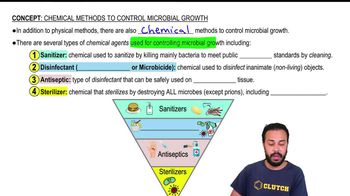
Step 5: Sanitization is the process of reducing microbial populations on inanimate objects to safe public health levels, which is the typical goal when disinfecting cafeteria plates.

Verified video answer for a similar problem:

This video solution was recommended by our tutors as helpful for the problem above.
Video duration:
2m
Was this helpful?

Key Concepts

Here are the essential concepts you must grasp in order to answer the question correctly.

Pasteurization

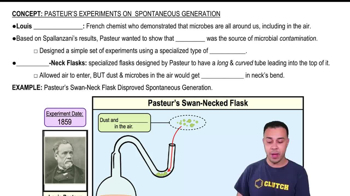
Pasteurization is a heat treatment process that reduces microbial load in liquids like milk and juice to safe levels, but it does not eliminate all microorganisms. It is not typically used for disinfecting solid objects like plates.
Recommended video:
Guided course
03:53
Pasteur's Experiments on Spontaneous Generation

Antisepsis

Antisepsis refers to the use of chemical agents to destroy or inhibit microorganisms on living tissues, such as skin or mucous membranes. It is not appropriate for inanimate objects like cafeteria plates.

Sanitization

Sanitization is the process of reducing microbial populations on inanimate objects to safe public health levels, often used for cleaning dishes, utensils, and surfaces. It lowers the risk of disease transmission without necessarily achieving complete sterility.
Recommended video:
Guided course
03:58
Chemical Methods to Control Microbial Growth