Ch. 9 - Controlling Microbial Growth in the Environment
Bauman - Microbiology with Diseases by Taxonomy 6th Edition
Bauman6th EditionMicrobiology with Diseases by TaxonomyISBN: 9780134832302Not the one you use?Change textbook
Chapter 9, Problem 20

Which class of surfactant is most soluble in water?
a. Quaternary ammonium compounds
b. Alcohols
c. Soaps
d. Peracetic acids

Verified step by step guidance
1
Understand that surfactants are compounds that lower the surface tension between two substances, such as water and oil, and their solubility in water depends on their chemical structure, especially the hydrophilic (water-attracting) part.
Review the classes of surfactants given: Quaternary ammonium compounds (cationic surfactants), Alcohols (nonionic surfactants), Soaps (anionic surfactants), and Peracetic acids (oxidizing agents, not typical surfactants).
Recall that soaps are salts of fatty acids and are generally very soluble in water because they have a strong hydrophilic ionic head group that interacts well with water molecules.
Compare the solubility of quaternary ammonium compounds, which are also water-soluble but may have varying solubility depending on their alkyl chain length, and alcohols, which have limited solubility depending on their chain length and polarity.
Conclude that among the options, soaps are typically the most soluble in water due to their ionic nature and strong hydrophilic groups.

Verified video answer for a similar problem:

This video solution was recommended by our tutors as helpful for the problem above.
Video duration:
2m
Was this helpful?

Key Concepts

Here are the essential concepts you must grasp in order to answer the question correctly.

Surfactant Classes and Their Properties

Surfactants are compounds that lower surface tension between two substances, such as water and oil. They are classified into types like anionic, cationic, nonionic, and amphoteric, each with distinct chemical structures and solubility characteristics.
Recommended video:
Guided course
04:43
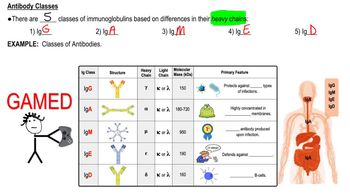
Classes of Antibodies

Water Solubility of Surfactants

Water solubility depends on the surfactant's hydrophilic (water-attracting) head group and hydrophobic tail. Surfactants with ionic or polar head groups tend to be more soluble in water, while those with nonpolar groups are less soluble.
Recommended video:
Guided course
01:29
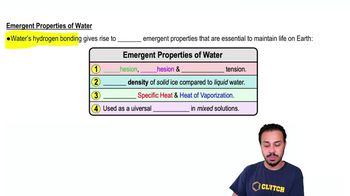
Introduction to Water

Characteristics of Quaternary Ammonium Compounds and Soaps

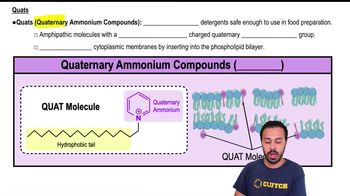
Quaternary ammonium compounds are cationic surfactants with positively charged nitrogen, making them highly soluble in water. Soaps are anionic surfactants formed from fatty acids and are also water-soluble but can precipitate in hard water due to ion interactions.
Recommended video: