Ch. 3 - Cell Structure and Function
Bauman - Microbiology with Diseases by Taxonomy 6th Edition
Bauman6th EditionMicrobiology with Diseases by TaxonomyISBN: 9780134832302Not the one you use?Change textbook
Chapter 3, Problem 12

Gram-positive bacteria  __________.


a. have a thick cell wall, which retains crystal violet dye
b. contain teichoic acids in their cell walls
c. appear purple after Gram staining
d. all of the above

Verified step by step guidance
1
Understand the characteristics of Gram-positive bacteria, focusing on their cell wall structure and staining properties.
Recall that Gram-positive bacteria have a thick peptidoglycan layer in their cell walls, which is responsible for retaining the crystal violet dye during Gram staining.
Recognize that teichoic acids are unique components found in the cell walls of Gram-positive bacteria, contributing to their structural integrity and antigenic properties.
Know that after the Gram staining procedure, Gram-positive bacteria appear purple due to the retention of the crystal violet-iodine complex in their thick cell wall.
Combine these points to conclude that all the given statements (a, b, and c) correctly describe Gram-positive bacteria, leading to the answer 'd. all of the above'.

Verified video answer for a similar problem:

This video solution was recommended by our tutors as helpful for the problem above.
Video duration:
2m
Was this helpful?

Key Concepts

Here are the essential concepts you must grasp in order to answer the question correctly.

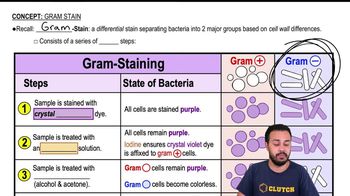
Gram Staining Technique

Gram staining is a differential staining method used to classify bacteria into Gram-positive or Gram-negative based on their cell wall properties. Gram-positive bacteria retain the crystal violet dye, appearing purple under a microscope, due to their thick peptidoglycan layer.
Recommended video:

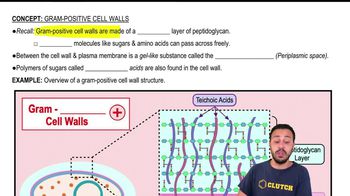
Cell Wall Structure of Gram-Positive Bacteria

Gram-positive bacteria have a thick peptidoglycan layer in their cell walls, which is responsible for retaining the crystal violet stain during Gram staining. This thick layer provides structural support and protection against environmental stresses.
Recommended video:
Guided course
02:59
Gram-Positive Cell Walls

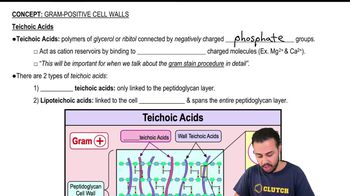
Teichoic Acids in Gram-Positive Bacteria

Teichoic acids are unique components found in the cell walls of Gram-positive bacteria. They play roles in cell wall maintenance, ion regulation, and can contribute to the bacteria's ability to cause disease by interacting with host tissues.
Recommended video:
Guided course
03:58
Teichoic Acids