Ch. 26 - Applied and Industrial Microbiology
Bauman - Microbiology with Diseases by Taxonomy 6th Edition
Bauman6th EditionMicrobiology with Diseases by TaxonomyISBN: 9780134832302Not the one you use?Change textbook
Chapter 26, Problem 11

Lyophilization in food preservation is by ________.
a. Cell lysis
b. Gamma radiation
c. Rapid heating
d. Freeze-drying

Verified step by step guidance
1
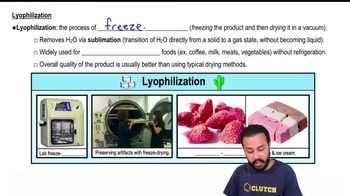
Understand the term 'lyophilization': it is a process used in food preservation that involves removing water from a product after it is frozen, by sublimation (transition of water from solid to gas phase without passing through liquid).
Recall that lyophilization is commonly known as freeze-drying, which helps preserve food by preventing microbial growth and enzymatic activity that require water.
Evaluate each option: (a) cell lysis refers to breaking down cells, not a preservation method; (b) gamma radiation is a sterilization method using ionizing radiation; (c) rapid heating is a method that can kill microbes but is not lyophilization; (d) freeze-drying matches the definition of lyophilization.
Conclude that lyophilization in food preservation is achieved by freeze-drying, which removes moisture while maintaining the structure and nutrients of the food.
Therefore, the correct answer corresponds to option (d) freeze-drying.

Verified video answer for a similar problem:

This video solution was recommended by our tutors as helpful for the problem above.
Video duration:
1m
Was this helpful?

Key Concepts

Here are the essential concepts you must grasp in order to answer the question correctly.

Lyophilization

Lyophilization, or freeze-drying, is a dehydration process used to preserve perishable materials by freezing them and then reducing the surrounding pressure to allow frozen water to sublimate directly from solid to gas. This method helps maintain the structure and nutritional content of food.
Recommended video:
Guided course
02:34
Lyophilization

Food Preservation Methods

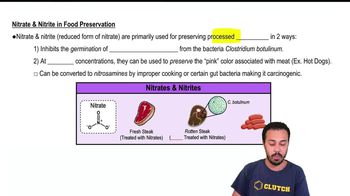
Food preservation techniques aim to prevent spoilage by inhibiting microbial growth or enzymatic activity. Common methods include drying, freezing, radiation, and chemical treatments, each working through different mechanisms like moisture removal or microbial inactivation.
Recommended video:
Guided course
03:15
Nitrate & Nitrite in Food Preservation

Mechanisms of Microbial Inactivation

Microbial inactivation can occur through various mechanisms such as cell lysis, heat denaturation, or radiation damage. Understanding these helps differentiate preservation methods like gamma radiation, which kills microbes, from lyophilization, which primarily removes water to inhibit growth.
Recommended video:
Guided course
01:59
Introduction to Avoiding Host Defense Mechanisms