
Ch. 26 - Applied and Industrial Microbiology
Bauman - Microbiology with Diseases by Taxonomy 6th Edition
Bauman6th EditionMicrobiology with Diseases by TaxonomyISBN: 9780134832302Not the one you use?Change textbook
Chapter 26, Problem 2

Indicate whether the following statement is true or false. Rewrite the underlined phrase to make a false statement true.
______ Sauerkraut production involves the alcoholic fermentation of cabbage.

Verified step by step guidance
1
Step 1: Understand the type of fermentation involved in sauerkraut production. Sauerkraut is made by fermenting cabbage using specific bacteria.
Step 2: Recall that sauerkraut fermentation is primarily a lactic acid fermentation process, not alcoholic fermentation. This means lactic acid bacteria convert sugars into lactic acid.
Step 3: Identify the underlined phrase 'alcoholic fermentation' as incorrect in the context of sauerkraut production.
Step 4: To make the statement true, replace 'alcoholic fermentation' with 'lactic acid fermentation' because this accurately describes the biochemical process in sauerkraut production.
Step 5: The corrected statement should read: 'Sauerkraut production involves the lactic acid fermentation of cabbage.'

Verified video answer for a similar problem:

This video solution was recommended by our tutors as helpful for the problem above.
Video duration:
1m
Was this helpful?

Key Concepts

Here are the essential concepts you must grasp in order to answer the question correctly.

Types of Fermentation

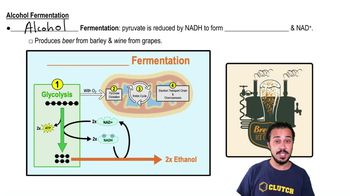
Fermentation is a metabolic process that converts sugars into acids, gases, or alcohol. The main types include alcoholic fermentation, which produces ethanol and CO2, and lactic acid fermentation, which produces lactic acid. Understanding these types helps distinguish the fermentation involved in different food processes.
Recommended video:
Guided course
02:02
Alcohol Fermentation

Lactic Acid Fermentation in Food Production

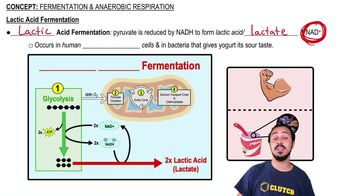
Lactic acid fermentation is a process where bacteria convert sugars into lactic acid, lowering pH and preserving food. It is responsible for the sour taste and preservation of foods like sauerkraut, yogurt, and kimchi. This process differs from alcoholic fermentation, which produces alcohol instead of acid.
Recommended video:
Guided course
03:34
Lactic Acid Fermentation

Microbial Role in Sauerkraut Production

Sauerkraut production relies on naturally occurring lactic acid bacteria that ferment cabbage sugars into lactic acid. These microbes create an acidic environment that preserves the cabbage and develops its characteristic flavor. Recognizing the specific microbes and their metabolic products is key to understanding sauerkraut fermentation.
Recommended video:
Guided course
01:16
Chemical Preservation of Perishable Products