Ch. 23 - Parasitic Protozoa, Helminths, and Arthropod Vectors
Bauman - Microbiology with Diseases by Taxonomy 6th Edition
Bauman6th EditionMicrobiology with Diseases by TaxonomyISBN: 9780134832302Not the one you use?Change textbook
Chapter 23, Problem 1

Match the numbered organism with the correct lettered term. Answers may be used more than once, and an organism may have more than one answer.


1. ___ Balantidium coli
2. ___ Echinococcus granulosus
3. ___ Fasciola spp.
4. ___ Leishmania spp.
5. ___ Plasmodium falciparum
6. ___ Plasmodium vivax
7. ___ Taenia spp.
8. ___ Toxoplasma gondii
9. ___ Trypanosoma
10. ___ Wuchereria bancrofti


A. Miracidia
B. Bradyzoites
C. Schizogony
D. Microfilaria
E. Hydatid cyst
F. Cysticerci
G. Trophozoites
H. Amastigotes
I. Hypnozoites
J. Flagellated trypanosomes

Verified step by step guidance
1
Step 1: Identify the type of organism for each numbered item (e.g., protozoan, helminth) and recall their life cycle stages or forms relevant to the lettered terms.
Step 2: For Balantidium coli (1), recognize it as a ciliate protozoan and match it with the appropriate life stage or form from the options.
Step 3: For Echinococcus granulosus (2) and Taenia spp. (7), both are cestodes (tapeworms), so identify terms related to larval cyst forms such as hydatid cyst (E) or cysticerci (F).
Step 4: For protozoan parasites like Leishmania spp. (4), Plasmodium falciparum (5), Plasmodium vivax (6), Toxoplasma gondii (8), and Trypanosoma (9), match their specific life cycle stages such as trophozoites (G), amastigotes (H), schizogony (C), hypnozoites (I), or flagellated trypanosomes (J).
Step 5: For Wuchereria bancrofti (10), a filarial nematode, identify the larval stage term microfilaria (D) and assign it accordingly.

Verified video answer for a similar problem:

This video solution was recommended by our tutors as helpful for the problem above.
Video duration:
3m
Was this helpful?

Key Concepts

Here are the essential concepts you must grasp in order to answer the question correctly.

Parasitic Life Cycles and Stages

Understanding the complex life cycles of parasites, including their various developmental stages such as cysts, larvae, and trophozoites, is essential. Each stage has distinct morphological and functional characteristics that relate to transmission, infection, and diagnosis. Recognizing these stages helps in matching organisms to their corresponding terms.
Recommended video:

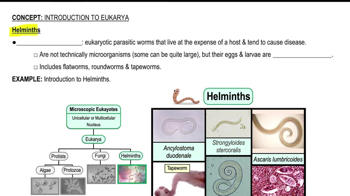
Protozoan vs Helminth Parasites

Differentiating between protozoan parasites (unicellular organisms like Plasmodium and Leishmania) and helminth parasites (multicellular worms like Taenia and Wuchereria) is crucial. Their biology, life cycles, and terminology differ significantly, influencing how terms like microfilaria or hydatid cyst apply to them.
Recommended video:

Terminology of Parasitic Forms

Familiarity with specific parasitological terms such as miracidia, bradyzoites, schizogony, microfilaria, hydatid cyst, cysticerci, trophozoites, amastigotes, hypnozoites, and flagellated trypanosomes is vital. These terms describe particular forms or stages of parasites, reflecting their morphology, reproduction, or infective potential.
Recommended video:
Guided course
03:09
Hierarchy of Microbial Growth Control Terminology