____________ may be transmitted to humans from cat litter boxes.
Ch. 23 - Parasitic Protozoa, Helminths, and Arthropod Vectors
Bauman6th EditionMicrobiology with Diseases by TaxonomyISBN: 9780134832302Not the one you use?Change textbook
All textbooks
Bauman 6th Edition
Ch. 23 - Parasitic Protozoa, Helminths, and Arthropod Vectors
Problem 2
Bauman 6th Edition
Ch. 23 - Parasitic Protozoa, Helminths, and Arthropod Vectors
Problem 2Chapter 23, Problem 2
Mark each statement as true or false. Rewrite the false statements to make them true by changing the underlined word(s).
__________ Examination of stool samples can reveal the presence of Naegleria parasites.
Verified step by step guidance1
Step 1: Understand the organism mentioned. Naegleria is a genus of free-living amoebae, with Naegleria fowleri being the most well-known species causing primary amoebic meningoencephalitis, a brain infection.
Step 2: Recall the typical diagnostic samples for Naegleria infections. Naegleria fowleri infections are usually diagnosed by examining cerebrospinal fluid (CSF), not stool samples.
Step 3: Evaluate the statement: 'Examination of stool samples can reveal the presence of Naegleria parasites.' Since Naegleria infects the brain and central nervous system, stool samples are not the correct specimen for detection.
Step 4: Rewrite the false statement by replacing 'stool samples' with the correct specimen type, which is 'cerebrospinal fluid samples.' The corrected statement should read: 'Examination of cerebrospinal fluid samples can reveal the presence of Naegleria parasites.'
Step 5: Summarize the key point: Naegleria parasites are detected in CSF, not stool, because their infection site is the brain, not the gastrointestinal tract.

Verified video answer for a similar problem:
This video solution was recommended by our tutors as helpful for the problem above.
Video duration:
1mWas this helpful?
Key Concepts
Here are the essential concepts you must grasp in order to answer the question correctly.
Naegleria and Its Habitat
Naegleria is a genus of free-living amoebae commonly found in warm freshwater environments, not in the human gastrointestinal tract or stool samples. It is important to know that Naegleria primarily causes infections through the nasal passages, not via fecal contamination.
Recommended video:
Guided course
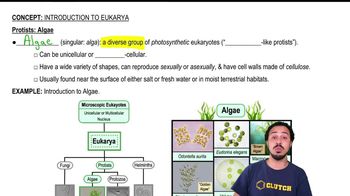
Protists:Algae
Diagnostic Samples for Naegleria Infection
Diagnosis of Naegleria infections, such as primary amoebic meningoencephalitis, typically involves examining cerebrospinal fluid (CSF) rather than stool samples. Understanding which clinical specimens are appropriate for detecting specific pathogens is crucial in microbiology.
Recommended video:
Guided course
Map of Lesson on Bacteriophage Infections
True/False Question Correction Strategy
When correcting false statements, identify the inaccurate term and replace it with the correct one to make the statement true. This approach helps clarify misconceptions and reinforces accurate microbiological knowledge.
Recommended video:
Guided course
Predictions, Hypotheses, & Theories
Related Practice
Textbook Question
5
views
Textbook Question
Parasitology is the study of parasitic:
a. A.viruses
b. Prokaryotes
c. Fungi
d. Eukaryotes
5
views
Textbook Question
The only ciliate to cause disease in humans is __________.
a. Naegleria
b. Balantidium
c. Fasciola
d. Trypanosoma
Textbook Question
How is the transmission of the amoeba Entamoeba different from the transmission of the amoebas Acanthamoeba and Naegleria?
4
views
Textbook Question
Label the three stages of the Plasmodium life cycle and label the forms of the parasite where indicated.
2
views
Textbook Question
Identify the genera of the parasites in these clinical specimens.
<IMAGE> <IMAGE>
fecal anal
a. ________ b. _________
<IMAGE> <IMAGE>
blood fecal
c. _________ d. _________
<IMAGE> <IMAGE>
vaginal blood
e. _________ f. __________
<IMAGE> <IMAGE>
fecal fecal
g. ___________ h. ___________