

Ch. 21 - Rickettsias, Chlamydias, Spirochetes, and Vibrios
Bauman - Microbiology with Diseases by Taxonomy 6th Edition
Bauman6th EditionMicrobiology with Diseases by TaxonomyISBN: 9780134832302Not the one you use?Change textbook
Chapter 21, Problem 1

Most human infections caused by species of Rickettsia ___________.
a. Are acquired from fomites
b. Could be prevented by hand washing
c. Are transmitted via vectors
d. Are sexually transmitted

Verified step by step guidance
1
Step 1: Understand the nature of Rickettsia species. These are obligate intracellular bacteria that typically require a vector for transmission because they cannot survive long outside host cells.
Step 2: Review the common modes of transmission for Rickettsia infections. They are primarily transmitted by arthropod vectors such as ticks, lice, fleas, or mites.
Step 3: Evaluate each option in the context of Rickettsia transmission: (a) fomites are inanimate objects and are not a common source for Rickettsia; (b) hand washing is generally effective against pathogens transmitted by direct contact but less relevant for vector-borne diseases; (c) vectors are known to transmit Rickettsia; (d) sexual transmission is not a recognized route for Rickettsia infections.
Step 4: Conclude that the correct answer is the option that states Rickettsia infections are transmitted via vectors.
Step 5: Remember that understanding the transmission mode is crucial for prevention strategies, which in the case of Rickettsia involves controlling vector exposure rather than relying solely on hygiene measures like hand washing.

Verified video answer for a similar problem:

This video solution was recommended by our tutors as helpful for the problem above.
Video duration:
1m
Was this helpful?

Key Concepts

Here are the essential concepts you must grasp in order to answer the question correctly.

Rickettsia Transmission Modes

Rickettsia species are obligate intracellular bacteria primarily transmitted to humans through arthropod vectors such as ticks, fleas, and lice. Understanding their transmission is crucial, as it differs from infections spread by direct contact or fomites.
Recommended video:
Guided course
04:23
Transmission Electron Microscope (TEM)

Role of Vectors in Infectious Diseases

Vectors are living organisms that transmit pathogens between hosts. In the case of Rickettsia, vectors like ticks facilitate the bacteria's entry into humans, making vector control a key strategy in preventing these infections.
Recommended video:
Guided course
05:09
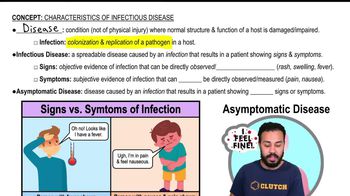
Intro to Characteristics of Infectious Disease

Prevention of Vector-Borne Diseases

Preventing infections caused by vector-borne pathogens involves measures such as avoiding vector exposure, using insect repellents, and controlling vector populations. Unlike diseases spread by fomites or direct contact, hand washing alone is insufficient to prevent Rickettsia infections.
Recommended video:
Guided course
04:57
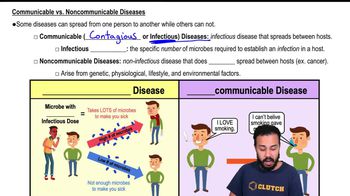
Communicable vs. Noncommunicable Diseases