Ch. 21 - Rickettsias, Chlamydias, Spirochetes, and Vibrios
Bauman - Microbiology with Diseases by Taxonomy 6th Edition
Bauman6th EditionMicrobiology with Diseases by TaxonomyISBN: 9780134832302Not the one you use?Change textbook
Chapter 21, Problem 6

Beginning with the ingestion of water contaminated with V. cholerae O1 El Tor, describe the course of the disease it causes.

Verified step by step guidance
1
Step 1: Understand the initial infection process by recognizing that ingestion of water contaminated with Vibrio cholerae O1 El Tor introduces the bacteria into the small intestine, where they survive the acidic environment of the stomach to reach the intestinal mucosa.
Step 2: Describe how V. cholerae adheres to the epithelial cells of the small intestine using its pili and other surface structures, establishing colonization without invading the intestinal tissue.
Step 3: Explain that once attached, the bacteria produce cholera toxin (an AB5 toxin), which enters the epithelial cells and activates adenylate cyclase, leading to increased cyclic AMP (cAMP) levels.
Step 4: Detail how elevated cAMP causes secretion of chloride ions and water into the intestinal lumen, resulting in the characteristic profuse, watery diarrhea known as 'rice-water stools,' which leads to rapid dehydration.
Step 5: Summarize the clinical course, emphasizing the importance of fluid and electrolyte replacement to prevent severe dehydration and shock, and note that without treatment, the disease can be fatal.

Verified video answer for a similar problem:

This video solution was recommended by our tutors as helpful for the problem above.
Video duration:
2m
Was this helpful?

Key Concepts

Here are the essential concepts you must grasp in order to answer the question correctly.

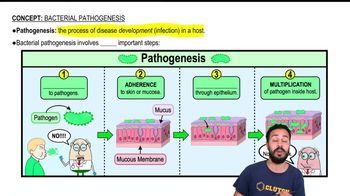
Pathogenesis of Vibrio cholerae

Vibrio cholerae O1 El Tor causes cholera by colonizing the small intestine after ingestion. It produces cholera toxin, which disrupts ion transport in intestinal cells, leading to massive water loss and severe diarrhea. Understanding this mechanism explains the rapid dehydration characteristic of the disease.
Recommended video:
Guided course
02:35
Intro to Bacterial Pathogenesis

Transmission and Infection Route

Cholera is typically transmitted through ingestion of water contaminated with V. cholerae. The bacteria survive stomach acid and reach the small intestine, where they multiply. Recognizing the fecal-oral transmission route is essential for understanding disease spread and prevention.
Recommended video:
Guided course
04:23
Transmission Electron Microscope (TEM)

Clinical Manifestations and Disease Progression

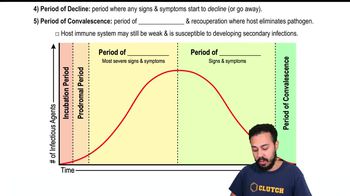
After ingestion, symptoms appear within hours to days, starting with watery diarrhea and vomiting. If untreated, rapid dehydration can lead to shock and death. Early recognition and rehydration therapy are critical to managing the disease effectively.
Recommended video:
Guided course
05:36
Stages of Infectious Disease Progression