Ch. 2 - The Chemistry of Microbiology
Bauman - Microbiology with Diseases by Taxonomy 6th Edition
Bauman6th EditionMicrobiology with Diseases by TaxonomyISBN: 9780134832302Not the one you use?Change textbook
Chapter 2, Problem 2

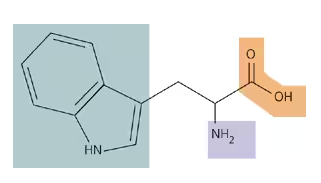
Shown is the amino acid tryptophan. Put the letter “C” at the site of every carbon atom. Label the amino group, the carboxyl group, and the side group.
Structural diagram of tryptophan with carbon atoms labeled "C" and amino, carboxyl, and side groups identified.

Verified step by step guidance
1
Identify all the carbon atoms in the tryptophan molecule. Each carbon atom is part of the backbone or the side chain. Mark each carbon atom with the letter "C" on the structure.
Locate the amino group, which consists of a nitrogen atom bonded to two hydrogen atoms (NH2). This group is attached to the alpha carbon (the central carbon atom next to the carboxyl group). Label this group as the amino group.
Find the carboxyl group, which contains a carbon atom double-bonded to an oxygen atom and single-bonded to a hydroxyl group (OH). This group is typically at one end of the amino acid structure. Label this as the carboxyl group.
Identify the side group (R group) specific to tryptophan. In this case, it is the indole ring, a bicyclic structure containing a benzene ring fused to a five-membered nitrogen-containing ring. Label this entire structure as the side group.
Review the labeled structure to ensure all carbon atoms are marked with "C", and the amino group, carboxyl group, and side group are correctly identified and labeled.

Verified video answer for a similar problem:

This video solution was recommended by our tutors as helpful for the problem above.
Video duration:
3m
Was this helpful?

Key Concepts

Here are the essential concepts you must grasp in order to answer the question correctly.

Structure of Amino Acids

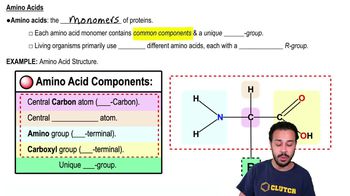
Amino acids have a central carbon atom (alpha carbon) bonded to an amino group (NH2), a carboxyl group (COOH), a hydrogen atom, and a unique side chain (R group). Understanding this basic structure is essential to identify and label each part correctly.
Recommended video:

Functional Groups in Amino Acids

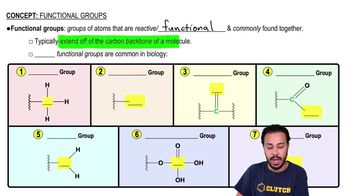
The amino group (NH2) acts as a base, and the carboxyl group (COOH) acts as an acid, giving amino acids their amphoteric properties. Recognizing these groups helps in labeling and understanding their chemical behavior in proteins.
Recommended video:
Guided course
06:04
Functional Groups

Side Chain (R Group) Specificity

The side chain or R group defines the identity and properties of each amino acid. For tryptophan, the side chain includes a complex indole ring, which affects its chemical behavior and interactions in proteins.
Recommended video:
Guided course
06:04
Functional Groups