Ch. 19 - Pathogenic Gram-Positive Bacteria
Bauman - Microbiology with Diseases by Taxonomy 6th Edition
Bauman6th EditionMicrobiology with Diseases by TaxonomyISBN: 9780134832302Not the one you use?Change textbook
Chapter 19, Problem 10

In which of the following diseases would a patient experience a pseudomembrane covering the tonsils, pharynx, and larynx?
a. Tuberculoid leprosy
b. Diphtheria
c. Arrhythmia
d. Tetanus

Verified step by step guidance
1
Step 1: Understand the term 'pseudomembrane' — it refers to a false membrane composed of dead cells, fibrin, bacteria, and inflammatory cells that can cover mucous membranes during certain infections.
Step 2: Review the diseases listed and their typical clinical features: Tuberculoid leprosy primarily affects the skin and peripheral nerves; arrhythmia is a heart rhythm disorder and not an infectious disease; tetanus causes muscle spasms due to a neurotoxin but does not produce pseudomembranes.
Step 3: Focus on diphtheria, which is caused by Corynebacterium diphtheriae. This bacterium produces a toxin that leads to the formation of a thick, gray pseudomembrane on the tonsils, pharynx, and larynx.
Step 4: Recall that the pseudomembrane in diphtheria can cause airway obstruction and is a hallmark sign used in diagnosis.
Step 5: Conclude that among the options, diphtheria is the disease associated with a pseudomembrane covering the tonsils, pharynx, and larynx.

Verified video answer for a similar problem:

This video solution was recommended by our tutors as helpful for the problem above.
Video duration:
2m
Was this helpful?

Key Concepts

Here are the essential concepts you must grasp in order to answer the question correctly.

Pseudomembrane Formation

A pseudomembrane is a layer of dead cells, fibrin, and inflammatory debris that forms on mucous membranes during certain infections. It often appears as a thick, grayish coating that can obstruct airways, commonly seen in diseases like diphtheria.
Recommended video:
Guided course
03:08
Formation & Breakdown of Polysaccharides

Diphtheria Pathogenesis

Diphtheria is caused by Corynebacterium diphtheriae, which produces a toxin leading to local tissue damage and pseudomembrane formation in the throat. This membrane can cover the tonsils, pharynx, and larynx, causing breathing difficulties and systemic toxicity.
Recommended video:
Guided course
02:35
Intro to Bacterial Pathogenesis

Differential Diagnosis of Infectious Diseases

Understanding symptoms and signs helps differentiate diseases. Tuberculoid leprosy affects skin and nerves, arrhythmia is a heart rhythm disorder, and tetanus causes muscle spasms. Only diphtheria is associated with pseudomembrane formation in the respiratory tract.
Recommended video:
Guided course
05:09
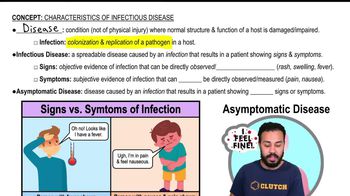
Intro to Characteristics of Infectious Disease