Ch. 19 - Pathogenic Gram-Positive Bacteria
Bauman - Microbiology with Diseases by Taxonomy 6th Edition
Bauman6th EditionMicrobiology with Diseases by TaxonomyISBN: 9780134832302Not the one you use?Change textbook
Chapter 19, Problem 3

Contrast tuberculoid leprosy with lepromatous leprosy in terms of pathogenesis. How does the cellular immune response of a patient affect the form of the disease?

Verified step by step guidance
1
Understand that tuberculoid and lepromatous leprosy represent two polar forms of the disease caused by Mycobacterium leprae, differing mainly in the host's immune response and bacterial load.
Recognize that in tuberculoid leprosy, the patient mounts a strong cell-mediated immune (CMI) response, particularly a Th1-type response, which activates macrophages to contain the bacteria effectively, leading to fewer lesions and low bacterial numbers.
Note that in lepromatous leprosy, the cellular immune response is weak or absent, with a predominant Th2-type response that fails to activate macrophages adequately, allowing widespread bacterial proliferation and numerous lesions.
Contrast the pathogenesis by explaining that tuberculoid leprosy is characterized by well-formed granulomas and nerve involvement due to effective immune containment, whereas lepromatous leprosy shows diffuse infiltration of macrophages filled with bacteria and minimal granuloma formation.
Summarize that the form of leprosy a patient develops depends largely on the strength and type of their cellular immune response: a strong CMI leads to tuberculoid leprosy, while a poor CMI leads to lepromatous leprosy.

Verified video answer for a similar problem:

This video solution was recommended by our tutors as helpful for the problem above.
Video duration:
2m
Was this helpful?

Key Concepts

Here are the essential concepts you must grasp in order to answer the question correctly.

Pathogenesis of Tuberculoid and Lepromatous Leprosy

Tuberculoid leprosy is characterized by a strong cell-mediated immune response that limits bacterial growth, resulting in localized lesions and fewer bacteria. In contrast, lepromatous leprosy involves a weak cellular immune response, allowing widespread bacterial proliferation and diffuse lesions.
Recommended video:
Guided course
02:35
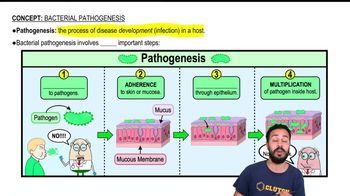
Intro to Bacterial Pathogenesis

Cellular Immune Response in Leprosy

The cellular immune response, particularly the activity of T-helper 1 (Th1) cells, is crucial in controlling Mycobacterium leprae infection. A robust Th1 response activates macrophages to kill bacteria, leading to tuberculoid leprosy, while a deficient response results in lepromatous leprosy with uncontrolled bacterial growth.
Recommended video:
Guided course
02:57
Intro to Immune Response Damage

Clinical and Immunological Spectrum of Leprosy

Leprosy presents as a spectrum from tuberculoid to lepromatous forms, determined by the host's immune response. Tuberculoid leprosy shows strong immunity and few bacteria, whereas lepromatous leprosy shows poor immunity and abundant bacteria, influencing disease severity and transmission.
Recommended video:
Guided course
04:29
Electromagnetic Spectrum