Ch. 17 - Immunization and Immune Testing
Bauman - Microbiology with Diseases by Taxonomy 6th Edition
Bauman6th EditionMicrobiology with Diseases by TaxonomyISBN: 9780134832302Not the one you use?Change textbook
Chapter 17, Problem 2

The two columns on the left show negative and positive immunoblot results for a particular pathogen. The numbered columns are blots of samples from 11 patients. Which patients are most likely uninfected?
<IMAGE>

Verified step by step guidance
1
Step 1: Understand the purpose of the immunoblot (Western blot) test shown. The negative control (−) shows no bands, indicating no antibody binding, while the positive control (+) shows multiple bands, indicating the presence of antibodies against the pathogen proteins.
Step 2: Compare each patient sample (lanes 1 to 11) to the positive and negative controls. Patients with bands similar to the positive control likely have antibodies against the pathogen, indicating infection.
Step 3: Identify patients whose lanes show no bands or only faint bands similar to the negative control. These patients likely do not have antibodies against the pathogen and are therefore most likely uninfected.
Step 4: Specifically, look for the absence of bands at the positions where the positive control shows strong bands. Patients lacking these bands are considered negative for infection.
Step 5: Summarize which patient lanes resemble the negative control pattern most closely, indicating uninfected individuals.

Verified video answer for a similar problem:

This video solution was recommended by our tutors as helpful for the problem above.
Video duration:
2m
Was this helpful?

Key Concepts

Here are the essential concepts you must grasp in order to answer the question correctly.

Immunoblot (Western Blot) Technique

Immunoblotting is a laboratory method used to detect specific proteins in a sample by using antibodies. Proteins are separated by gel electrophoresis, transferred to a membrane, and then probed with antibodies that bind to target antigens. The presence of bands indicates antigen-antibody reactions, which help identify infection or immune response.
Recommended video:
Guided course
03:31
Southern Blotting

Positive and Negative Controls in Immunoblot

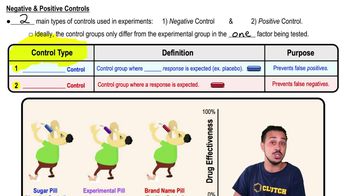
Controls are essential for interpreting immunoblot results. A positive control contains known target proteins and shows expected band patterns, confirming the test works. A negative control lacks the target proteins and should show no bands, ensuring specificity. Comparing patient samples to controls helps determine infection status.
Recommended video:
Guided course
07:42
Negative & Positive Controls

Interpreting Patient Sample Bands for Infection Status

Patient samples showing band patterns similar to the positive control indicate the presence of antibodies against the pathogen, suggesting infection. Samples resembling the negative control, with no or faint bands, likely indicate uninfected individuals. Careful comparison of band intensity and pattern is crucial for accurate diagnosis.
Recommended video:
Guided course
04:09
Productive vs. Latent State Infections