Ch. 17 - Immunization and Immune Testing
Bauman - Microbiology with Diseases by Taxonomy 6th Edition
Bauman6th EditionMicrobiology with Diseases by TaxonomyISBN: 9780134832302Not the one you use?Change textbook
Chapter 17, Problem 1

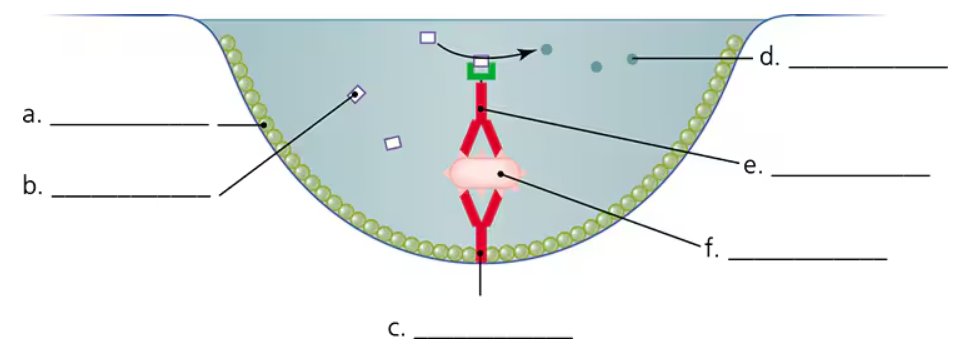
Identify the chemicals represented by this artist’s conception of an antibody sandwich ELISA.
Diagram of an antibody sandwich ELISA showing antigen binding between capture and detection antibodies with labeled components.

Verified step by step guidance
1
Step 1: Identify the component labeled 'a'. This is the solid surface or well where the assay takes place, typically a microtiter plate well coated with a capture antibody.
Step 2: Identify the component labeled 'b'. This is the capture antibody that is immobilized on the solid surface and is specific to the antigen of interest.
Step 3: Identify the component labeled 'c'. This is the antigen that binds specifically to the capture antibody, forming the first part of the 'sandwich'.
Step 4: Identify the component labeled 'd'. This is the detection antibody, which binds to a different epitope on the antigen, allowing for specific detection.
Step 5: Identify the components labeled 'e' and 'f'. 'e' is the enzyme conjugated to the detection antibody, which catalyzes a colorimetric or other detectable reaction, and 'f' is the substrate that the enzyme acts upon to produce a measurable signal.

Verified video answer for a similar problem:

This video solution was recommended by our tutors as helpful for the problem above.
Video duration:
2m
Was this helpful?

Key Concepts

Here are the essential concepts you must grasp in order to answer the question correctly.

Capture Antibody

The capture antibody is immobilized on the surface of the well and specifically binds to the target antigen. It serves as the first layer in the sandwich ELISA, ensuring that only the antigen of interest is retained for detection.
Recommended video:

Antigen

The antigen is the molecule of interest that is specifically recognized and bound by both the capture and detection antibodies. It is 'sandwiched' between these antibodies, allowing for its identification and quantification.
Recommended video:

Detection Antibody and Enzyme Label

The detection antibody binds to a different epitope on the antigen and is linked to an enzyme (such as horseradish peroxidase). This enzyme catalyzes a colorimetric reaction when substrate is added, producing a measurable signal proportional to antigen concentration.
Recommended video:
Guided course
06:49
Mutant Detection