Ch. 16 - Adaptive Immunity
Bauman - Microbiology with Diseases by Taxonomy 6th Edition
Bauman6th EditionMicrobiology with Diseases by TaxonomyISBN: 9780134832302Not the one you use?Change textbook
Chapter 16, Problem 8

Which cells express MHC class I molecules in a patient?
a. Red blood cells
b. Antigen-presenting cells only
c. Neutrophils only
d. All nucleated cells
e. Dendritic cells only

Verified step by step guidance
1
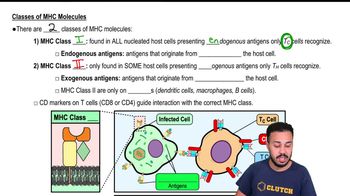
Understand the role of MHC class I molecules: MHC class I molecules present endogenous antigens (from inside the cell) to CD8+ cytotoxic T cells, which is crucial for immune surveillance against infected or abnormal cells.
Recall the expression pattern of MHC class I molecules: They are expressed on almost all nucleated cells in the body, allowing the immune system to monitor the health of these cells.
Consider exceptions: Red blood cells (erythrocytes) are anucleate (lack a nucleus) and therefore do not express MHC class I molecules.
Evaluate the options given: Since MHC class I molecules are not limited to antigen-presenting cells or neutrophils but are found on all nucleated cells, options specifying only certain cell types are incorrect.
Conclude that the correct answer corresponds to the option indicating expression on all nucleated cells, reflecting the broad distribution of MHC class I molecules.

Verified video answer for a similar problem:

This video solution was recommended by our tutors as helpful for the problem above.
Video duration:
2m
Was this helpful?

Key Concepts

Here are the essential concepts you must grasp in order to answer the question correctly.

Major Histocompatibility Complex (MHC) Class I Molecules

MHC class I molecules are proteins found on the surface of almost all nucleated cells. They present endogenous peptides to cytotoxic T cells, enabling the immune system to detect infected or abnormal cells. Their expression is crucial for immune surveillance and is absent on red blood cells, which lack nuclei.
Recommended video:
Guided course
02:31
Major Histocompatibility Complex Molecules

Cell Types Expressing MHC Molecules

While antigen-presenting cells (APCs) like dendritic cells express both MHC class I and II molecules, MHC class I is not limited to APCs. Instead, all nucleated cells, including neutrophils and other somatic cells, express MHC class I, allowing broad immune monitoring across tissues.
Recommended video:
Guided course
07:17
Classes of MHC Molecules

Role of Red Blood Cells in Immunity

Red blood cells (RBCs) lack nuclei and therefore do not express MHC class I molecules. This absence means RBCs cannot present antigens to T cells, distinguishing them from other cell types in immune recognition and response.
Recommended video:
Guided course
06:08
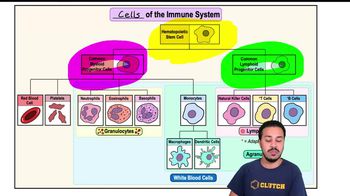
Map of the Lesson on Cells of the Immune System