Ch. 14 - Infection, Infectious Diseases, and Epidemiology
Bauman - Microbiology with Diseases by Taxonomy 6th Edition
Bauman6th EditionMicrobiology with Diseases by TaxonomyISBN: 9780134832302Not the one you use?Change textbook
Chapter 14, Problem 3

Which of the following is false concerning microbial contaminants?
a. Contaminants may become opportunistic pathogens.
b. Most microbial contaminants will eventually cause harm.
c. Contaminants may be a part of the transient microbiota.
d. Contaminants may be introduced by a mosquito bite.

Verified step by step guidance
1
Step 1: Understand the definition of microbial contaminants. These are unwanted microorganisms that are present in a particular environment, such as a laboratory setting or on surfaces, and are not intended to be there.
Step 2: Analyze option (a): 'Contaminants may become opportunistic pathogens.' This is true because some microbes that are normally harmless can cause disease if they enter a susceptible host or a different environment.
Step 3: Analyze option (b): 'Most microbial contaminants will eventually cause harm.' Consider that many contaminants are harmless or transient and do not necessarily cause disease, so this statement is likely false.
Step 4: Analyze option (c): 'Contaminants may be a part of the transient microbiota.' This is true because transient microbiota are microbes temporarily present on or in the body and can be considered contaminants in certain contexts.
Step 5: Analyze option (d): 'Contaminants may be introduced by a mosquito bite.' This is true since mosquitoes can carry and introduce microbial pathogens into a host, acting as vectors.

Verified video answer for a similar problem:

This video solution was recommended by our tutors as helpful for the problem above.
Video duration:
3m
Was this helpful?

Key Concepts

Here are the essential concepts you must grasp in order to answer the question correctly.

Opportunistic Pathogens

Opportunistic pathogens are microbes that normally do not cause disease but can become harmful when the host's immune system is weakened or when they enter normally sterile areas. Understanding this helps explain how some contaminants can lead to infections under certain conditions.
Recommended video:
Guided course
03:40
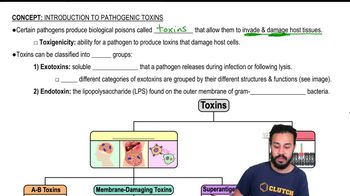
Introduction to Pathogenic Toxins

Transient Microbiota

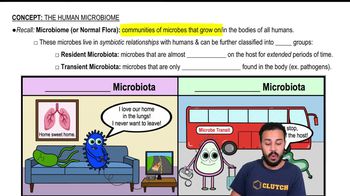
Transient microbiota are microorganisms that temporarily colonize the body without causing disease. They differ from resident microbiota and can include contaminants that do not establish permanent presence but may still interact with the host.
Recommended video:
Guided course
03:25
The Human Microbiome

Microbial Contamination and Harm

Not all microbial contaminants cause harm; many are harmless or eliminated by the immune system. Recognizing that most contaminants do not inevitably lead to disease is crucial for evaluating statements about microbial contamination.
Recommended video:
Guided course
03:49
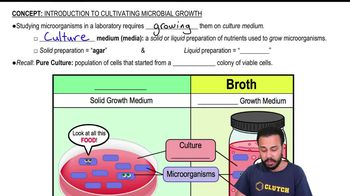
Introduction to Cultivating Microbial Growth