Ch. 14 - Infection, Infectious Diseases, and Epidemiology
Bauman - Microbiology with Diseases by Taxonomy 6th Edition
Bauman6th EditionMicrobiology with Diseases by TaxonomyISBN: 9780134832302Not the one you use?Change textbook
Chapter 14, Problem 1

List four types of symbiotic relationships, and give an example of each.

Verified step by step guidance
1
Understand that symbiotic relationships are close and long-term biological interactions between two different species, which can be beneficial, harmful, or neutral to one or both organisms.
Identify the four main types of symbiotic relationships: mutualism, commensalism, parasitism, and amensalism.
For mutualism, explain that both species benefit from the relationship. An example is the relationship between nitrogen-fixing bacteria and leguminous plants.
For commensalism, describe that one species benefits while the other is neither helped nor harmed. An example is barnacles attaching to whales, gaining mobility and access to food without affecting the whale.
For parasitism, clarify that one organism benefits at the expense of the other. An example is a tapeworm living in the intestines of mammals, absorbing nutrients and harming the host.

Verified video answer for a similar problem:

This video solution was recommended by our tutors as helpful for the problem above.
Video duration:
2m
Was this helpful?

Key Concepts

Here are the essential concepts you must grasp in order to answer the question correctly.

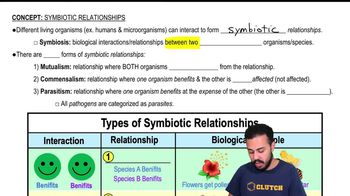
Symbiotic Relationships

Symbiotic relationships are close and long-term interactions between different species. These interactions can affect the survival, growth, or reproduction of the organisms involved, and they are classified based on the benefits or harms experienced by each partner.
Recommended video:
Guided course
05:59
Symbiotic Relationships

Types of Symbiosis

The four main types of symbiotic relationships are mutualism, commensalism, parasitism, and amensalism. Each type describes a different pattern of benefit or harm between the interacting species, ranging from both benefiting to one harmed and the other unaffected.
Recommended video:
Guided course
01:06
Types of Phosphorylation

Examples of Symbiotic Relationships

Examples help illustrate each type: mutualism (bees and flowers, both benefit), commensalism (barnacles on whales, barnacles benefit, whales unaffected), parasitism (tapeworms in intestines, parasite benefits, host harmed), and amensalism (penicillium mold inhibiting bacteria, mold unaffected, bacteria harmed).
Recommended video:
Guided course
05:59
Symbiotic Relationships