Ch. 13 - Characterizing and Classifying Viruses, Viroids, and Prions
Bauman - Microbiology with Diseases by Taxonomy 6th Edition
Bauman6th EditionMicrobiology with Diseases by TaxonomyISBN: 9780134832302Not the one you use?Change textbook
Chapter 13, Problem 2

Which of the following statements is true?
a. Viruses move toward their host cells.
b. Viruses are capable of metabolism.
c. Viruses lack a cytoplasmic membrane.
d. Viruses grow in response to their environmental conditions.

Verified step by step guidance
1
Step 1: Understand the nature of viruses. Viruses are acellular entities that require a host cell to replicate and do not carry out independent metabolic processes.
Step 2: Analyze option (a): 'Viruses move toward their host cells.' Viruses do not have motility structures and cannot move actively; they rely on passive mechanisms to come into contact with host cells.
Step 3: Analyze option (b): 'Viruses are capable of metabolism.' Viruses lack the cellular machinery necessary for metabolism and depend entirely on the host cell's metabolic systems.
Step 4: Analyze option (c): 'Viruses lack a cytoplasmic membrane.' Unlike cells, viruses do not have a cytoplasmic membrane; they are typically composed of a protein coat (capsid) and sometimes a lipid envelope derived from the host.
Step 5: Analyze option (d): 'Viruses grow in response to their environmental conditions.' Viruses do not grow or increase in size; they assemble from components synthesized inside the host cell.

Verified video answer for a similar problem:

This video solution was recommended by our tutors as helpful for the problem above.
Video duration:
2m
Was this helpful?

Key Concepts

Here are the essential concepts you must grasp in order to answer the question correctly.

Virus Structure

Viruses are composed of genetic material (DNA or RNA) enclosed in a protein coat called a capsid. Unlike cells, they lack a cytoplasmic membrane, which is a lipid bilayer found in cellular organisms. This structural difference is key to distinguishing viruses from living cells.
Recommended video:
Guided course
02:33
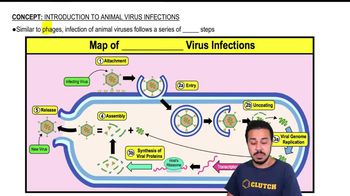
Introduction to Animal Virus Infections

Viral Metabolism

Viruses do not possess metabolic machinery and cannot carry out metabolic processes on their own. They rely entirely on host cells to provide energy and molecular components for replication, making them metabolically inert outside a host.
Recommended video:
Guided course
02:17
Introduction to Metabolism

Viral Movement and Growth

Viruses do not move actively toward host cells; instead, they rely on passive mechanisms like diffusion or host movement. Additionally, viruses do not grow or change size; they assemble from preformed components inside host cells rather than growing in response to environmental conditions.
Recommended video:
Guided course
02:43
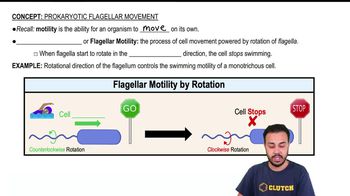
Prokaryotic Flagellar Movement